Advertisements
Advertisements
Question
A rectangular path of 60 m length and 3 m width is covered by square tiles of side 25 cm. How many tiles will there be in one row along its width? How many such rows will be there? Find the number of tiles used to make this path?
Advertisements
Solution
Given, Length of path = 60 m
And width of path = 30 m
Side of square tile = 25 cm
= `25/100` m ...[∵ 1 m = 100 cm]
= 0.25 m
Diagram of path is shown below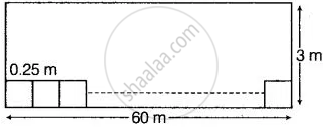
Number of tiles in one row along width = `"Width"/"Side of one tile"`
= `3/0.25`
= `(3 xx 100)/25`
= 12
Number of rows = `"Length"/"Side of one tile"`
= `60/0.25`
= `60/25 xx 100`
= 240
Also, number of tiles = Number of tiles in one row × Number of rows
= 12 × 240
= 2880
APPEARS IN
RELATED QUESTIONS
The length of a rectangle is 16 cm and its perimeter is equal to the perimeter of a square with side 12.5 cm. Find the area of the rectangle.
Find the perimeter of a regular hexagon of side 6.5 cm.
Find the cost of fencing a rectangular park of length 250 m and breadth 175 m at the rate of Rs. 12 per metre.
If the length of a rectangle is 20 m and its width is 12 m, what is its perimeter?
Four rounds of wire fence have to be put around a field. If the field is 60 m long and 40 m wide, how much wire will be needed?
How many different rectangles can be made with a 48 cm long string? Find the possible pairs of length and breadth of the rectangles.
Length of a rectangle is three times its breadth. Perimeter of the rectangle is 40 cm. Find its length and width.
An increase in perimeter of a figure always increases the area of the figure.
A hedge boundary needs to be planted around a rectangular lawn of size 72 m × 18 m. If 3 shrubs can be planted in a metre of hedge, how many shrubs will be planted in all?
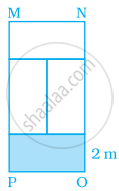
Rectangle MNOP is made up of four congruent rectangles (see figure). If the area of one of the rectangles is 8 m2 and breadth is 2 m, then find the perimeter of MNOP.