Advertisements
Advertisements
Question
A rectangular conducting loop consists of two wires on two opposite sides of length l joined together by rods of length d. The wires are each of the same material but with cross-sections differing by a factor of 2. The thicker wire has a resistance R and the rods are of low resistance, which in turn are connected to a constant voltage source V0. The loop is placed in uniform a magnetic field B at 45° to its plane. Find τ, the torque exerted by the magnetic field on the loop about an axis through the centres of rods.
Advertisements
Solution
After analyzing the direction of current in both wires, magnetic forces and torques need to be calculated for finding the net torque.
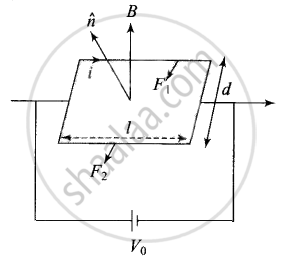
Front view
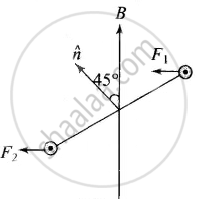
Side view
According to the problem, the thicker wire has a resistance R, then the other wire has a resistance 2R as the wires are of the same material so their resistivity remains same.
Now, the force and hence, torque on first wire is given by
`F_1 = i_1 lB sin 90^circ = V_circ/(2R) lB`,
`τ_1 = d/(2sqrt(2)) F_1 = (V_0ldB)/(2sqrt(2)R)`
Similarly, the force hence torque on other wire is given by
`F_2 = i_2 lB sin 90^circ = V_circ/(2R) lB`,
`τ_2 = d/(2sqrt(2)) F_2 = (V_0ldB)/(4sqrt(2)R)`
So, net torque, `τ = τ_1 - τ_2`
`τ = 1/(4sqrt(2)) = (V_0AB)/R`
Where A is the area of rectangular coil.
APPEARS IN
RELATED QUESTIONS
In a chamber, a uniform magnetic field of 6.5 G (1 G = 10–4 T) is maintained. An electron is shot into the field with a speed of 4.8 × 10⁶ m s−1 normal to the field. Explain why the path of the electron is a circle. Determine the radius of the circular orbit. (e = 1.5 × 10⁻¹⁹ C, me = 9.1 × 10⁻³¹ kg)
A rectangular loop of wire of size 4 cm × 10 cm carries a steady current of 2 A. A straight long wire carrying 5 A current is kept near the loop as shown. If the loop and the wire are coplanar, find
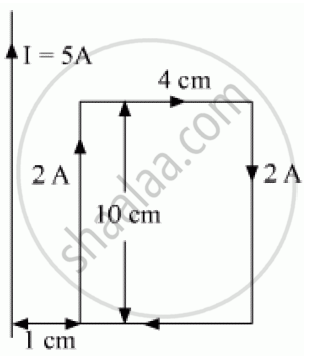
(i) the torque acting on the loop and
(ii) the magnitude and direction of the force on the loop due to the current carrying wire.
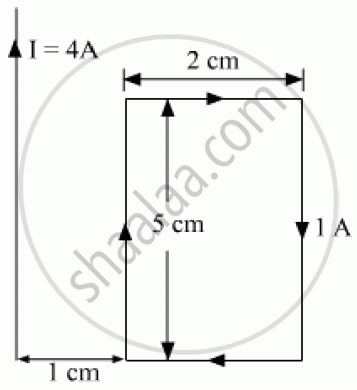
A rectangular loop of wire of size 2 cm × 5 cm carries a steady current of 1 A. A straight long wire carrying 4 A current is kept near the loop as shown. If the loop and the wire are coplanar, find (i) the torque acting on the loop and (ii) the magnitude and direction of the force on the loop due to the current carrying wire.
A rectangular loop of size l × b carrying a steady current I is placed in a uniform magnetic field `vecB`. Prove that the torque `vectau`acting on the loop is give by `vectau =vecm xx vecB,`where `vecm` is the magnetic moment of the loop.
A magnetised needle of magnetic moment 4.8 × 10⁻² JT−1 is placed at 30° with the direction of uniform magnetic field of magnitude 3 × 10⁻² T. Calculate the torque acting on the needle.
The rectangular wire-frame, shown in figure, has a width d, mass m, resistance R and a large length. A uniform magnetic field B exists to the left of the frame. A constant force F starts pushing the frame into the magnetic field at t = 0. (a) Find the acceleration of the frame when its speed has increased to v. (b) Show that after some time the frame will move with a constant velocity till the whole frame enters into the magnetic field. Find this velocity v0. (c) Show that the velocity at time t is given by
v = v0(1 − e−Ft/mv0).
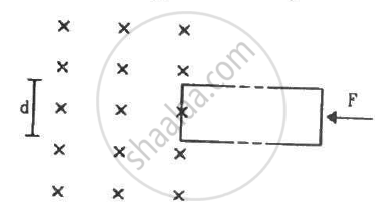
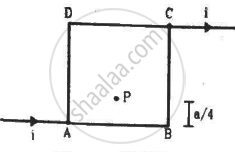
Figure shows a square loop of edge a made of a uniform wire. A current i enters the loop at the point A and leaves it at the point C. Find the magnetic field at the point P which is on the perpendicular bisector of AB at a distance a/4 from it.
Find the magnetic field B at the centre of a rectangular loop of length l and width b, carrying a current i.
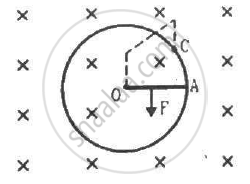
Figure shows a conducting circular loop of radius a placed in a uniform, perpendicular magnetic field B. A thick metal rod OA is pivoted at the centre O. The other end of the rod touches the loop at A. The centre O and a fixed point C on the loop are connected by a wire OC of resistance R. A force is applied at the middle point of the rod OAperpendicularly, so that the rod rotates clockwise at a uniform angular velocity ω. Find the force.
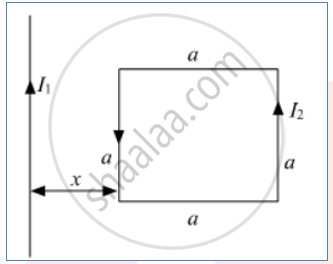
A square loop of side 'a' carrying a current I2 is kept at distance x from an infinitely long straight wire carrying a current I1 as shown in the figure. Obtain the expression for the resultant force acting on the loop.
Consider the motion of a charged particle in a uniform magnetic field directed into the paper. If velocity v of the particle is in the plane of the paper the charged particle will ______.
- Assertion (A): The deflecting torque acting on a current-carrying loop is zero when its plane is perpendicular to the direction of the magnetic field.
- Reason (R): The deflecting torque acting on a loop of the magnetic moment `vecm` in a magnetic field `vecB` is given by the dot product of `vecm` and `vecB`.
