Advertisements
Advertisements
Question
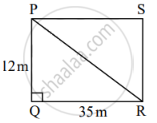
A rectangle having dimensions 35 m × 12 m, then what is the length of its diagonal?
Advertisements
Solution

Let PQRS be the given rectangle.
In ∆PQR,
∠Q = 90° ...[Angle of a rectangle]
∴ PR2 = PQ2 + QR2 ...[Pythagoras theorem]
= 122 + 352
= 144 + 1225
= 1369
∴ PR = `sqrt(1369)` ...[Taking square root of both sides]
= 37 m
∴ The length of the diagonal of the given rectangle is 37 m.
RELATED QUESTIONS
In the rectangle WXYZ, XY + YZ = 17 cm, and XZ + YW = 26 cm. Calculate the length and breadth of the rectangle?

The hypotenuse of a right triangle is 6 m more than twice of the shortest side. If the third side is 2 m less than the hypotenuse, find the sides of the triangle
In the adjacent figure, ABC is a right angled triangle with right angle at B and points D, E trisect BC. Prove that 8AE2 = 3AC2 + 5AD2

In a ∆ABC, AD is the bisector of ∠BAC. If AB = 8 cm, BD = 6 cm and DC = 3 cm. The length of the side AC is
Two poles of heights 6 m and 11 m stand vertically on a plane ground. If the distance between their feet is 12 m, what is the distance between their tops?
If the sides of a triangle are in the ratio 5 : 12 : 13 then, it is ________
8, 15, 17 is a Pythagorean triplet
Check whether given sides are the sides of right-angled triangles, using Pythagoras theorem
8, 15, 17
Check whether given sides are the sides of right-angled triangles, using Pythagoras theorem
12, 13, 15
In right angled triangle, if sum of the squares of the sides of right angle is 169, then what is the length of the hypotenuse?
A rectangle having length of a side is 12 and length of diagonal is 20, then what is length of other side?
If length of both diagonals of rhombus are 60 and 80, then what is the length of side?
In ∆ABC, AB = `6sqrt(3)` cm, AC = 12 cm, and BC = 6 cm then m∠A = ?
If a triangle having sides 50 cm, 14 cm and 48 cm, then state whether given triangle is right angled triangle or not.
In ∆LMN, l = 5, m = 13, n = 12 then complete the activity to show that whether the given triangle is right angled triangle or not.
*(l, m, n are opposite sides of ∠L, ∠M, ∠N respectively)
Activity: In ∆LMN, l = 5, m = 13, n = `square`
∴ l2 = `square`, m2 = 169, n2 = 144.
∴ l2 + n2 = 25 + 144 = `square`
∴ `square` + l2 = m2
∴ By Converse of Pythagoras theorem, ∆LMN is right angled triangle.
In ΔABC, AB = 9 cm, BC = 40 cm, AC = 41 cm. State whether ΔABC is a right-angled triangle or not. Write reason.
In a right angled triangle, right-angled at B, lengths of sides AB and AC are 5 cm and 13 cm, respectively. What will be the length of side BC?