English

A Ray Pq Incident on the Face Ab of a Prism Abc, as Shown in the Figure, Emerges from the Face Ac Such that Aq = Ar. - Physics

Advertisements
Advertisements

Question

A ray PQ incident on the face AB of a prism ABC, as shown in the figure, emerges from the face AC such that AQ = AR.
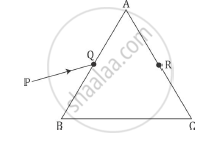
Draw the ray diagram showing the passage of the ray through the prism. If the angle of the prism is 60° and refractive index of the material of prism is `sqrt3` , determine the values of angle of incidence and angle of deviation

Advertisements

Solution

Given that side AQ = AR. This implies that ∠AQR = ∠ ARQ.

The ray diagram for the refraction of ray PQ passing through the prism ABC is as shown below.
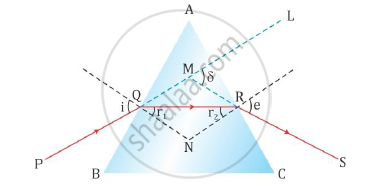
As the ray PQ after refraction from surface AB emerges from face AC at point R of the prism, it implies that the refracted ray QR travels parallel to the base of the prism. This happens at the minimum deviation position. So, according to the angle of minimum deviation formula, we have

`mu=(sin(A+delta_m)/2)/(sinA/2)" .......1"`

where A is the angle of prism δmis the angle of minimum deviation and μ is the refractive index of the prism.

Given A =60° , n = `sqrt3`

Substituting in (1) we get:

`sqrt3=(sin""(60^@+delta_m)/2)/(sin60^@/2)`

`sqrt3xxsin30^@=sin""((60^@+delta_m))/2`

`sqrt3/2=sin"" ((60^@+delta_m))/2`

`sin^(-1)(sqrt3/2)=((60^@+delta_m))/2`

`60^@=((60^@+delta_m))/2`

120° = (60°+δm)

⇒ δm = 60°

Thus, the angle of minimum deviation = 60°.

At the minimum deviation position,

`i=(A+delta_m)/2`

We know A = 60°, δm = 60°

Substituting we get:

`i=(60^@+60^@)/2`

⇒ i = 60°

shaalaa.com
  Is there an error in this question or solution?
2014-2015 (March) Panchkula Set 3

Video TutorialsVIEW ALL [2]

RELATED QUESTIONS

A ray of light passes through an equilateral glass prism such that the angle of incidence is equal to the angle of emergence and each of these angles is equal to 3/4 of angle of prism. Find the angle of deviation.


What is a dispersion of light


Draw the ray diagram showing refraction of light through a glass prism and hence obtain the relation between the refractive index μ of the prism, angle of prism and angle of minimum deviation.


Describe an activity to show that the colours of white light splitted by a glass prism can be recombined to get white light by another identical glass prism. Also, draw a ray diagram to show the recombination of the spectrum of white light.


Figure shows a ray of light passing through a prism. If the refracted ray QR is parallel to the base BC, show that (i) r1 = r2 = A/2 and (ii) angle of minimum deviation, Dm = 2i − A.


 Out of blue and red light which is deviated more by a prism? Give reason.


If three identical prisms are combined, is it possible to pass a beam that emerges undeviated? Undispersed?


A thin prism is made of a material having refractive indices 1.61 and 1.65 for red and violet light. The dispersive power of the material is 0.07. It is found that a beam of yellow light passing through the prism suffers a minimum deviation of 4.0° in favourable conditions. Calculate the angle of the prism.


Calculate dispersive power of a transparent material given : nv = 1.56, nr = 1.54, ny = 1.55. 


How does the angle of minimum deviation of a glass prism vary if the incident violet light is replaced by red light?


Share
Notifications

Englishहिंदीमराठी


      Forgot password?
Use app×