Advertisements
Advertisements
प्रश्न
A ray PQ incident on the face AB of a prism ABC, as shown in the figure, emerges from the face AC such that AQ = AR.
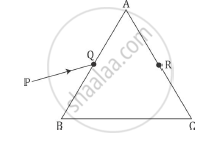
Draw the ray diagram showing the passage of the ray through the prism. If the angle of the prism is 60° and refractive index of the material of prism is `sqrt3` , determine the values of angle of incidence and angle of deviation
Advertisements
उत्तर
Given that side AQ = AR. This implies that ∠AQR = ∠ ARQ.
The ray diagram for the refraction of ray PQ passing through the prism ABC is as shown below.
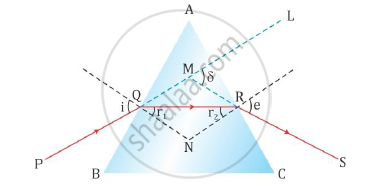
As the ray PQ after refraction from surface AB emerges from face AC at point R of the prism, it implies that the refracted ray QR travels parallel to the base of the prism. This happens at the minimum deviation position. So, according to the angle of minimum deviation formula, we have
`mu=(sin(A+delta_m)/2)/(sinA/2)" .......1"`
where A is the angle of prism δmis the angle of minimum deviation and μ is the refractive index of the prism.
Given A =60° , n = `sqrt3`
Substituting in (1) we get:
`sqrt3=(sin""(60^@+delta_m)/2)/(sin60^@/2)`
`sqrt3xxsin30^@=sin""((60^@+delta_m))/2`
`sqrt3/2=sin"" ((60^@+delta_m))/2`
`sin^(-1)(sqrt3/2)=((60^@+delta_m))/2`
`60^@=((60^@+delta_m))/2`
120° = (60°+δm)
⇒ δm = 60°
Thus, the angle of minimum deviation = 60°.
At the minimum deviation position,
`i=(A+delta_m)/2`
We know A = 60°, δm = 60°
Substituting we get:
`i=(60^@+60^@)/2`
⇒ i = 60°
APPEARS IN
संबंधित प्रश्न
A ray of light passes through an equilateral glass prism such that the angle of incidence is equal to the angle of emergence and each of these angles is equal to 3/4 of angle of prism. Find the angle of deviation.
State any two difference between the primary rainbow and secondary rainbow
Draw the ray diagram showing refraction of light through a glass prism and hence obtain the relation between the refractive index μ of the prism, angle of prism and angle of minimum deviation.
Out of blue and red light which is deviated more by a prism? Give reason.
The equation \[\omega = \frac{\mu_u - \mu_r}{\mu - 1}\] was derived for a prism having small refracting angle. Is it also valid for a prism of large refracting angle? Is it also valid for a glass slab or a glass sphere?
The minimum deviations suffered by, yellow and violet beams passing through an equilateral transparent prism are 38.4°, 38.7° and 39.2° respectively. Calculate the dispersive power of the medium.
The deviation produced for violet, yellow and red lights for crown glass are 3.75°, 3.25° and 2.86° respectively. Calculate the dispersive power of the crown glass.
A narrow beam of monochromatic light, PQ, is incident normally on one face of an equiangular glass prism of refractive index 1.45. When the prism is immersed in a certain liquid, the ray makes a grazing emergence along the other face (See figure). Find the refractive index of this liquid. 
The refractive indices of material for red, violet and yellow colour light are 1.52, 1.62 and 1.59 respectively.
Calculate the dispersive power of the material. If the mean deviation is 40°. What will be the angular dispersion produced by a prism of this material?
Prove that in case of a prism, i + e = A + δ, where the symbols have their usual meanings.
