Advertisements
Advertisements
Question
A ray of light passing through the point (1, 2) reflects on the x-axis at point A and the reflected ray passes through the point (5, 3). Find the coordinates of A.
Advertisements
Solution
Let BC be the coordinate of that point A (a, 0) along the x-axis. AN is perpendicular to it. PA is an incident ray and AQ is a reflected ray.
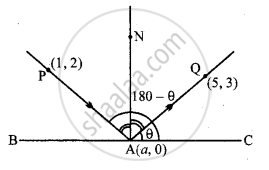
⇒ Angle of incidence PAN = Angle of reflection NAQ
⇒ ∠PAB = ∠QAC
⇒ If the inclination of QA is 0 then the inclination of PA will be 180 – θ.
Slope of QA when Q(5, 3) and A(a, 0) then
`tan θ = (0 - 3)/("a" - 5) = (-3)/("a" - 5)`
Slope of PA when P(1, 2) and A(a, 0), then
tan (180° - θ) = `(0 - 2)/("a" - 1)`
tan (180° - θ) = − tan θ
∴ `(-2)/("a" - 1) = (-3)/("a" - 5) = 3/("a" - 5)`
or −2(a − 5) = 3(a − 1)
or −2a + 10 = 3a − 3
or 5a = 13
or a = `13/5`
∴ The coordinates of point A is `(13/5, 0)`.
APPEARS IN
RELATED QUESTIONS
If the lines `(x-1)/2=(y+1)/3=(z-1)/4 ` and `(x-3)/1=(y-k)/2=z/1` intersect each other then find value of k
Find the distance of the point (–1, 1) from the line 12(x + 6) = 5(y – 2).
Find the distance between parallel lines l (x + y) + p = 0 and l (x + y) – r = 0
What are the points on the y-axis whose distance from the line `x/3 + y/4 = 1` is 4 units.
Find the equation of the line parallel to y-axis and drawn through the point of intersection of the lines x– 7y + 5 = 0 and 3x + y = 0.
Find the distance of the line 4x + 7y + 5 = 0 from the point (1, 2) along the line 2x – y = 0.
If sum of the perpendicular distances of a variable point P (x, y) from the lines x + y – 5 = 0 and 3x – 2y+ 7 = 0 is always 10. Show that P must move on a line.
Prove that the line y − x + 2 = 0 divides the join of points (3, −1) and (8, 9) in the ratio 2 : 3.
Find the distance of the point (3, 5) from the line 2x + 3y = 14 measured parallel to a line having slope 1/2.
Find the distance of the point (2, 5) from the line 3x + y + 4 = 0 measured parallel to a line having slope 3/4.
Find the distance of the point (2, 5) from the line 3x + y + 4 = 0 measured parallel to the line 3x − 4y+ 8 = 0.
The perpendicular distance of a line from the origin is 5 units and its slope is − 1. Find the equation of the line.
Find the perpendicular distance of the line joining the points (cos θ, sin θ) and (cos ϕ, sin ϕ) from the origin.
Show that the perpendiculars let fall from any point on the straight line 2x + 11y − 5 = 0 upon the two straight lines 24x + 7y = 20 and 4x − 3y − 2 = 0 are equal to each other.
What are the points on X-axis whose perpendicular distance from the straight line \[\frac{x}{a} + \frac{y}{b} = 1\] is a ?
Find the perpendicular distance from the origin of the perpendicular from the point (1, 2) upon the straight line \[x - \sqrt{3}y + 4 = 0 .\]
Show that the path of a moving point such that its distances from two lines 3x − 2y = 5 and 3x + 2y = 5 are equal is a straight line.
If sum of perpendicular distances of a variable point P (x, y) from the lines x + y − 5 = 0 and 3x − 2y + 7 = 0 is always 10. Show that P must move on a line.
Determine the distance between the pair of parallel lines:
y = mx + c and y = mx + d
The equations of two sides of a square are 5x − 12y − 65 = 0 and 5x − 12y + 26 = 0. Find the area of the square.
Find the ratio in which the line 3x + 4y + 2 = 0 divides the distance between the line 3x + 4y + 5 = 0 and 3x + 4y − 5 = 0
If the centroid of a triangle formed by the points (0, 0), (cos θ, sin θ) and (sin θ, − cos θ) lies on the line y = 2x, then write the value of tan θ.
If the lines x + ay + a = 0, bx + y + b = 0 and cx + cy + 1 = 0 are concurrent, then write the value of 2abc − ab − bc − ca.
Area of the triangle formed by the points \[\left( (a + 3)(a + 4), a + 3 \right), \left( (a + 2)(a + 3), (a + 2) \right) \text { and } \left( (a + 1)(a + 2), (a + 1) \right)\]
The line segment joining the points (−3, −4) and (1, −2) is divided by y-axis in the ratio
The value of λ for which the lines 3x + 4y = 5, 5x + 4y = 4 and λx + 4y = 6 meet at a point is
The vertices of a triangle are (6, 0), (0, 6) and (6, 6). The distance between its circumcentre and centroid is
A plane passes through (1, - 2, 1) and is perpendicular to two planes 2x - 2y + z = 0 and x - y + 2z = 4. The distance of the plane from the point (1, 2, 2) is ______.
The shortest distance between the lines
`bar"r" = (hat"i" + 2hat"j" + hat"k") + lambda (hat"i" - hat"j" + hat"k")` and
`bar"r" = (2hat"i" - hat"j" - hat"k") + mu(2hat"i" + hat"j" + 2hat"k")` is
If the tangent to the curve y = 3x2 - 2x + 1 at a point Pis parallel toy = 4x + 3, the co-ordinates of P are
Find the distance between the lines 3x + 4y = 9 and 6x + 8y = 15.
The distance of the point (2, – 3, 1) from the line `(x + 1)/2 = (y - 3)/3 = (z + 1)/-1` is ______.
The point of intersection of the diagonals of the rectangle whose sides are contained in the lines x = 8, x = 10, y = 11, and y =12 is
