Advertisements
Advertisements
Question
A ray of light incident at the optical centre of lens, passes undeviated after refraction.
Options
True
False
Advertisements
Solution
This statement is true.
APPEARS IN
RELATED QUESTIONS
What is a lens?
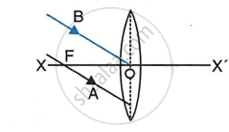
In the diagram below, XX’ represents the principal axis, O the optical centre and F the focus of the lens. Complete the path of rays A and B as they emerge out of the lens.
 |
 |
| (a) | (b) |
Study the diagram shown in the following Figure.
Name the lens LL’ and draw its outline.
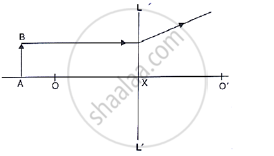
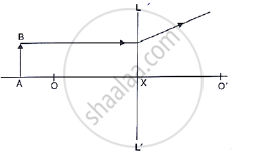
Study the diagram shown in Fig. 5.56
where is the object located?
For an object placed at a distance 20 cm in front of a convex lens, the image is at a distance 20 cm behind the lens. The focal length of the convex lens is ______.
State the condition of the following:
A ray passes undeviated through the lens.
Make the correct choices in the following items :
The image formed by a diverging lens, shown in fig, , is
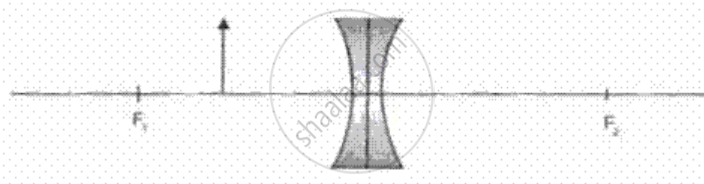
How will you differentiate between a convex and a concave lens by looking at a distant object.
When does a ray of light falling on a lens pass through it undeviated?
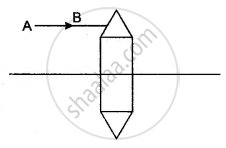
The diagram showed a lens as a combination of one glass block and two prisms. Complete the ray diagram and show the part of the incident ray AB after passing through the lens.
(i) Name of the lens formed by the combination.
(ii) What is the line XX’ called?
(iii) Mark the focus F.