Advertisements
Advertisements
Question
A point P (–2, 3) is reflected in line x = 2 to point P’. Find the co-ordinates of P’.
Advertisements
Solution
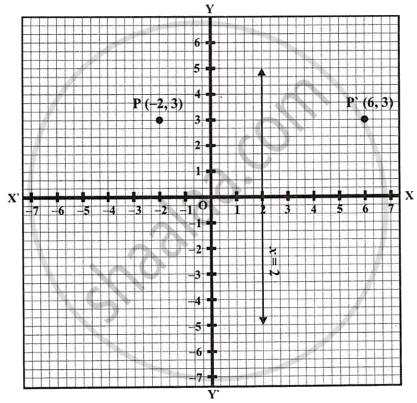
The image of P (–2, 3) is P' which is reflected in the line x = 2.
The co-ordinates of P' will be (6, 3) as shown in the graph.
APPEARS IN
RELATED QUESTIONS
Attempt this question on graph paper.
- Plot A (3, 2) and B (5, 4) on graph paper. Take 2 cm = 1 unit on both the axes.
- Reflect A and B in the x-axis to A’ and B’ respectively. Plot these points also on the same graph paper.
- Write down:
- the geometrical name of the figure ABB’A’;
- the measure of angle ABB’;
- the image of A” of A, when A is reflected in the origin.
- the single transformation that maps A’ to A”.
The points P (4, 1) and Q (–2, 4) are reflected in line y = 3. Find the co-ordinates of P’, the image of P and Q’, the image of Q.
Points A and B have co-ordinates (3, 4) and (0, 2) respectively. Find the image:
- A’ of A under reflection in the x-axis.
- B’ of B under reflection in the line AA’.
- A” of A under reflection in the y-axis.
- B” of B under reflection in the line AA”.
A (1, 1), B (5, 1), C (4, 2) and D (2, 2) are vertices of a quadrilateral. Name the quadrilateral ABCD. A, B, C, and D are reflected in the origin on to A’, B’, C’ and D’ respectively. Locate A’, B’, C’ and D’ on the graph sheet and write their co-ordinates. Are D, A, A’ and D’ collinear?
P and Q have co-ordinates (0, 5) and (–2, 4).
- P is invariant when reflected in an axis. Name the axis.
- Find the image of Q on reflection in the axis found in (a).
- (0, k) on reflection in the origin is invariant. Write the value of k.
- Write the co-ordinates of the image of Q, obtained by reflecting it in the origin followed by reflection in x-axis.
- The point P (2, –4) is reflected about the line x = 0 to get the image Q. Find the co-ordinates of Q.
- The point Q is reflected about the line y = 0 to get the image R. Find the co-ordinates of R.
- Name the figure PQR.
- Find the area of figure PQR.
A’ and B’ are images of A (-3, 5) and B (-5, 3) respectively on reflection in y-axis. Find: (
a) the co-ordinates of A’ and B’.
(b) Assign special name of quadrilateral AA’B’B.
(c) Are AB’ and BA’ equal in length?
Using a graph paper, plot the point A (6, 4) and B (0, 4).
(a) Reflect A and B in the origin to get the image A’ and B’.
(b) Write the co-ordinates of A’ and B’.
(c) Sate the geometrical name for the figure ABA’B’.
(d) Find its perimeter.
Use a graph paper for this question.
(Take 2 cm = 1 unit on both x and y axes)
- Plot the following points: A(0, 4), B(2, 3), C(1, 1) and D(2, 0).
- Reflect points B, C, D on the y-axis and write down their coordinates. Name the images as B', C', D' respectively.
- Join the points A, B, C, D, D', C', B' and A in order, so as to form a closed figure. Write down the equation to the line about which if this closed figure obtained is folded, the two parts of the figure exactly coincide.
Points (3, 0) and (−1, 0) are invarient points under reflection in the line L1; point (0, −3) and (0, 1) are invarient points on reflection in line L2.
- Write the equation of the line L1 and L2.
- Write down the images of points P(3, 4) and Q(−5, −2) on reflection in L1. Name the images as P' and Q' respectively.
- Write down the images of P and Q on reflection in L2. Name the image as P'' and Q'' respectively.
