Advertisements
Advertisements
Question
A (1, 1), B (5, 1), C (4, 2) and D (2, 2) are vertices of a quadrilateral. Name the quadrilateral ABCD. A, B, C, and D are reflected in the origin on to A’, B’, C’ and D’ respectively. Locate A’, B’, C’ and D’ on the graph sheet and write their co-ordinates. Are D, A, A’ and D’ collinear?
Advertisements
Solution
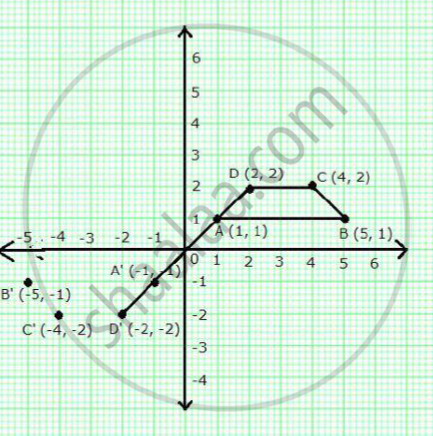
Quadrilateral ABCD is an isosceles trapezium.
Co-ordinates of A’, B’, C’ and D’ are A'(–1, –1), B'(–5, –1), C'(–4, –2) and D'(–2, –2) respectively.
It is clear from the graph that D, A, A’ and D’ are collinear.
APPEARS IN
RELATED QUESTIONS
Attempt this question on graph paper.
- Plot A (3, 2) and B (5, 4) on graph paper. Take 2 cm = 1 unit on both the axes.
- Reflect A and B in the x-axis to A’ and B’ respectively. Plot these points also on the same graph paper.
- Write down:
- the geometrical name of the figure ABB’A’;
- the measure of angle ABB’;
- the image of A” of A, when A is reflected in the origin.
- the single transformation that maps A’ to A”.
Points (3, 0) and (–1, 0) are invariant points under reflection in the line L1; points (0, –3) and (0, 1) are invariant points on reflection in line L2.
- Name or write equations for the lines L1 and L2.
- Write down the images of the points P (3, 4) and Q (–5, –2) on reflection in line L1. Name the images as P’ and Q’ respectively.
- Write down the images of P and Q on reflection in L2. Name the images as P” and Q” respectively.
- State or describe a single transformation that maps P’ onto P''.
- Point P (a, b) is reflected in the x-axis to P’ (5, –2). Write down the values of a and b.
- P” is the image of P when reflected in the y-axis. Write down the co-ordinates of P”.
- Name a single transformation that maps P’ to P”.
The points P (4, 1) and Q (–2, 4) are reflected in line y = 3. Find the co-ordinates of P’, the image of P and Q’, the image of Q.
Points A and B have co-ordinates (3, 4) and (0, 2) respectively. Find the image:
- A’ of A under reflection in the x-axis.
- B’ of B under reflection in the line AA’.
- A” of A under reflection in the y-axis.
- B” of B under reflection in the line AA”.
The point P (3, 4) is reflected to P’ in the x-axis; and O’ is the image of O (the origin) when reflected in the line PP’. Write:
- the co-ordinates of P’ and O’.
- the length of the segments PP’ and OO’.
- the perimeter of the quadrilateral POP’O’.
- the geometrical name of the figure POP’O’.
The triangle ABC, where A is (2, 6), B is (–3, 5) and C is (4, 7), is reflected in the y-axis to triangle A'B'C'. Triangle A'B'C' is then reflected in the origin to triangle A"B"C".
- Write down the co-ordinates of A", B" and C".
- Write down a single transformation that maps triangle ABC onto triangle A"B"C".
- The point P (2, –4) is reflected about the line x = 0 to get the image Q. Find the co-ordinates of Q.
- The point Q is reflected about the line y = 0 to get the image R. Find the co-ordinates of R.
- Name the figure PQR.
- Find the area of figure PQR.
A’ and B’ are images of A (-3, 5) and B (-5, 3) respectively on reflection in y-axis. Find: (
a) the co-ordinates of A’ and B’.
(b) Assign special name of quadrilateral AA’B’B.
(c) Are AB’ and BA’ equal in length?
Use graph paper for this question.
(Take 2 cm = 1 unit along both x-axis and y-axis.)
Plot the points O(0, 0), A(–4, 4), B(–3, 0) and C(0, –3).
- Reflect points A and B on the y-axis and name them A' and B' respectively. Write down their co-ordinates.
- Name the figure OABCB'A'.
- State the line of symmetry of this figure.
