Advertisements
Advertisements
Question
A point D is on the side BC of an equilateral triangle ABC such that \[DC = \frac{1}{4}BC\]. Prove that AD2 = 13CD2.
Advertisements
Solution
We are given ABC is an equilateral triangle with `CD = 1/4 BC`
We have to prove `AD^2 = 13DC^2`
Draw `AE ⊥ BC`
In ΔAEB and ΔAED we have `AB = AC`
`∠AEB = ∠AEC = 90^circ`
`AE = AE`
So by right side criterion of similarity we have
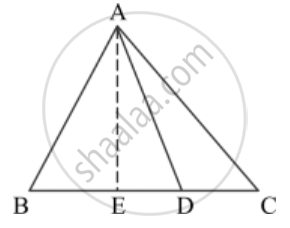
Thus we have
`DC =1/4BC and BE =EC = 1/2 BC`
Since `∠ C= 60^circ`, therefore
`AD^2 =AC^2+DC^2 - 2DC xxEC`
`AD^2 = AC^2+(1/4BC)^2-2xx1/4BCxx1/2BC`
`AD^2=AC^2+1/16BC^2-2xx1/4BCxx1/2BC`
`AD^2=AC^2+1/16BC^2-BC^2`
We know that AB = BC = AC
`AD^2=BC^2+1/16BC^2-BC^2`
`AD^2=(16BC^2+1BC^2-4BC^2)/16`
`AD^2=13/16BC^2`
We know that `DC = 1/4 BC`
`4DC=BC`
Substitute `4DC=BC` in `AD^2 =13/16BC^2 ` we get
`AD^2 = 13/16xx(4DC)^2`
`AD^2 = 13/16xx16DC^2`
`AD^2 = 13/16xx16xxDC^2`
`AD^2=13DC^2`
Hence we have proved that `AD^2 = 13 DC^2`
