English
Karnataka Board PUCPUC Science Class 11

A Particle of Mass M and Positive Charge Q, Moving with a Uniform Velocity V, Enters a Magnetic Field B, as Shown in the Figure. - Physics

Advertisements
Advertisements

Question

A particle of mass m and positive charge q, moving with a uniform velocity v, enters a magnetic field B, as shown in the figure. (a) Find the radius of the circular arc it describes in the magnetic field. (b) Find the angle subtended by the arc at the centre. (c) How long does the particle stay inside the magnetic field? (d) Solve the three parts of the above problem if the charge q on the particle is negative.
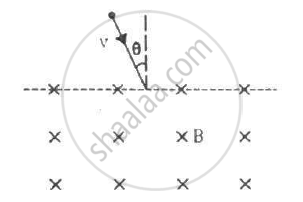
Sum
Advertisements

Solution

Given:-

Mass of the particle = m

Positive charge on the particle = q

Uniform velocity of the particle = v

Magnetic field = B


(a) The radius of the circular arc described by the particle in the magnetic field:-

We know

`r = (mv)/(qB)`


(b) 
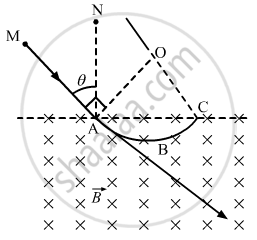
The angle subtended by the arc at the centre:-

Line MAB is tangent to arc ABC, so the angle described by the charged particle,

∠MAO = 90°

Now, ∠NAC = 90°

OAC = OCA = θ

[by geometry]

Then, AOC = 180° − (θ + θ) (By angle-sum property of a triangle)

= π − 2θ

(c) The time for which the particle stay inside the magnetic field:-

Distance covered by the particle inside the magnetic field,

l = rθ

`t = 1/v = m/(qB)(pi - 2theta)(U sing r = (mv)/(qB))`


(d) If the charge q on the particle is negative, then
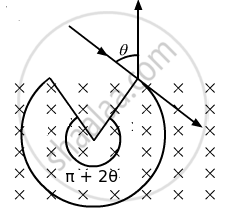
(i) Radius of circular arc, `r = (mv)/(qB)`

(ii) The centre of the arc will lie within the magnetic field. Therefore, the angle subtended by the arc = π + 2θ

(iii) Similarly, the time taken by the particle to cover the path inside the magnetic field = `m/(qB)(pi + 2theta)`

shaalaa.com
Force on a Moving Charge in Uniform Magnetic and Electric Fields
  Is there an error in this question or solution?
Chapter 12: Magnetic Field - Exercises [Page 233]

APPEARS IN

HC Verma Concepts of Physics Vol. 2 [English] Class 11 and 12
Chapter 12 Magnetic Field
Exercises | Q 38 | Page 233

RELATED QUESTIONS

A proton and an α-particle move perpendicular to a magnetic field. Find the ratio of radii of circular paths described by them when both have (i) equal velocities, and (ii) equal kinetic energy. 


A flexible wire of irregular shape, abcd, as shown in the figure, turns into a circular shape when placed in a region of magnetic field which is directed normal to the plane of the loop away from the reader. Predict the direction of the induced current in the wire.


A charged particle moves in a uniform magnetic field. The velocity of the particle at some instant makes an acute angle with the magnetic field. The path of the particle will be


A charged particle moves along a circle under the action of possible constant electric and magnetic fields. Which of the following is possible?
(a) E = 0, B = 0
(b) E = 0, B ≠ 0
(c) E ≠ 0, B = 0
(d) E ≠ 0, B ≠ 0


If a charged particle moves unaccelerated in a region containing electric and magnetic fields
(a) `vecE  "must be perpendicular" to vecB`
(b) `vecv "must be perpendicular" to vecE` 
(c) must be perpendicular to v_B


An experimenter's diary reads as follows: "A charged particle is projected in a magnetic field of `(7.0 vec i - 3.0 vecj)xx 10^-3 `T. The acceleration of the particle is found to be `(x veci + 7.0 vecj )` The number to the left of i in the last expression was not readable. What can this number be?


A 10 g bullet with a charge of 4.00 μC is fired at a speed of 270 m s−1 in a horizontal direction. A vertical magnetic field of 500 µT exists in the space. Find the deflection of the bullet due to the magnetic field as it travels through 100 m. Make appropriate approximations.


When a proton is released from rest in a room, it starts with an initial acceleration a0towards west. When it is projected towards north with a speed v0, it moves with an initial acceleration 3a0 towards west. Find the electric field and the maximum possible magnetic field in the room.


A metal wire PQ of mass 10 g lies at rest on two horizontal metal rails separated by 4.90 cm (figure). A vertically-downward magnetic field of magnitude 0.800 T exists in the space. The resistance of the circuit is slowly decreased and it is found that when the resistance goes below 20.0 Ω, the wire PQ starts sliding on the rails. Find the coefficient of friction.


A particle of charge 2.0 × 10⁻⁸ C and mass 2.0 × 10⁻¹⁰ g is projected with a speed of 2.0 × 10³ m s−1 in a region with a uniform magnetic field of 0.10 T. The velocity is perpendicular to the field. Find the radius of the circle formed by the particle and also the time period.


An electron of kinetic energy 100 eV circulates in a path of radius 10 cm in a magnetic field. Find the magnetic field and the number of revolutions per second made by the electron.


A square coil of edge l and with n turns carries a current i. It is kept on a smooth horizontal plate. A uniform magnetic field B exists parallel to an edge. The total mass of the coil is M. What should be the minimum value of B for which the coil will start tipping over?


A charged particle is accelerated through a potential difference of 12 kV and acquires a speed of 1.0 × 10⁶ m s−1. It is then injected perpendicularly into a magnetic field of strength 0.2 T. Find the radius of the circle described by it.


A narrow beam of singly charged potassium ions of kinetic energy 32 keV is injected into a region of width 1.00 cm with a magnetic field of strength 0.500 T, as shown in the figure. The ions are collected at a screen 95.5 cm away from the field region. If the beam contains isotopes of atomic weights 39 and 41, find the separation between the points where these isotopes strike the screen. Take the mass of a potassium ion = A (1.6 × 10⁻²⁷) kg, where A is the mass number.


Doubly-ionised helium ions are projected with a speed of 10 km s−1 in a direction perpendicular to a uniform magnetic field of magnitude 1.0 T. Find (a) the force acting on an ion (b) the radius of the circle in which it circulates and (c) the time taken by an ion to complete the circle.


A proton is projected with a velocity of 3 × 10⁶ m s−1 perpendicular to a uniform magnetic field of 0.6 T. Find the acceleration of the proton.


The figure shows a convex lens of focal length 12 cm lying in a uniform magnetic field Bof magnitude 1.2 T parallel to its principal axis. A particle with charge 2.0 × 10⁻³ C  and mass 2.0 × 10⁻⁵ kg is projected perpendicular to the plane of the diagram with a speed of 4.8 m s−1. The particle moves along a circle with its centre on the principal axis at a distance of 18 cm from the lens. Show that the image of the particle moves along a circle and find the radius of that circle.


Two parallel circular coils of equal radii having equal number of turns placed coaxially and separated by a distance equal to the radii of the coils carrying equal currents in same direction are known as ______.

A charged particle moves through a magnetic field in a direction perpendicular to it. Then the ______.

Share
Notifications

Englishहिंदीमराठी


      Forgot password?
Use app×