मराठी
कर्नाटक बोर्ड पी.यू.सी.पीयूसी विज्ञान इयत्ता ११

A Particle of Mass M and Positive Charge Q, Moving with a Uniform Velocity V, Enters a Magnetic Field B, as Shown in the Figure. - Physics

Advertisements
Advertisements

प्रश्न

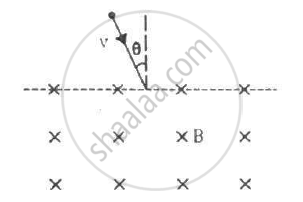
A particle of mass m and positive charge q, moving with a uniform velocity v, enters a magnetic field B, as shown in the figure. (a) Find the radius of the circular arc it describes in the magnetic field. (b) Find the angle subtended by the arc at the centre. (c) How long does the particle stay inside the magnetic field? (d) Solve the three parts of the above problem if the charge q on the particle is negative.
बेरीज
Advertisements

उत्तर

Given:-

Mass of the particle = m

Positive charge on the particle = q

Uniform velocity of the particle = v

Magnetic field = B


(a) The radius of the circular arc described by the particle in the magnetic field:-

We know

`r = (mv)/(qB)`


(b) 
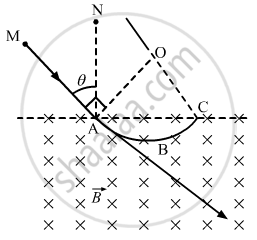
The angle subtended by the arc at the centre:-

Line MAB is tangent to arc ABC, so the angle described by the charged particle,

∠MAO = 90°

Now, ∠NAC = 90°

OAC = OCA = θ

[by geometry]

Then, AOC = 180° − (θ + θ) (By angle-sum property of a triangle)

= π − 2θ

(c) The time for which the particle stay inside the magnetic field:-

Distance covered by the particle inside the magnetic field,

l = rθ

`t = 1/v = m/(qB)(pi - 2theta)(U sing r = (mv)/(qB))`


(d) If the charge q on the particle is negative, then
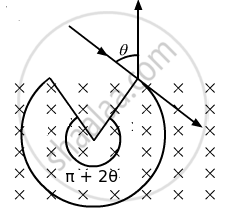
(i) Radius of circular arc, `r = (mv)/(qB)`

(ii) The centre of the arc will lie within the magnetic field. Therefore, the angle subtended by the arc = π + 2θ

(iii) Similarly, the time taken by the particle to cover the path inside the magnetic field = `m/(qB)(pi + 2theta)`

shaalaa.com
Force on a Moving Charge in Uniform Magnetic and Electric Fields
  या प्रश्नात किंवा उत्तरात काही त्रुटी आहे का?
पाठ 12: Magnetic Field - Exercises [पृष्ठ २३३]

APPEARS IN

एचसी वर्मा Concepts of Physics Vol. 2 [English] Class 11 and 12
पाठ 12 Magnetic Field
Exercises | Q 38 | पृष्ठ २३३

संबंधित प्रश्‍न

Write the expression, in a vector form, for the Lorentz magnetic force \[\vec{F}\] due to a charge moving with velocity \[\vec{V}\] in a magnetic field \[\vec{B}\]. What is the direction of the magnetic force? 


Show that the kinetic energy of the particle moving in a magnetic field remains constant.


A neutron, an electron and an alpha particle, moving with equal velocities, enter a uniform magnetic field going into the plane of the paper, as shown. Trace their paths in the field and justify your answer.


A proton and a deuteron having equal momenta enter in a region of a uniform magnetic field at right angle to the direction of a the field. Depict their trajectories in the field.


Assume that the magnetic field is uniform in a cubical region and zero outside. Can you project a charged particle from outside into the field, so that the particle describes a complete circle in the field?


A positively-charged particle projected towards east is deflected towards north by a magnetic field. The field may be


An electric current i enters and leaves a uniform circular wire of radius a through diametrically opposite points. A charged particle q, moving along the axis of the circular wire, passes through its centre at speed v. The magnetic force acting on the particle, when it passes through the centre, has a magnitude equal to


If a charged particle projected in a gravity-free room deflects, 
(a) there must be an electric field
(b) there must be a magnetic field
(c) both fields cannot be zero
(d) both fields can be non-zero


Prove that the force acting on a current-carrying wire, joining two fixed points a and b in a uniform magnetic field, is independent of the shape of the wire.


A current i is passed through a silver strip of width d and area of cross-section A. The number of free electrons per unit volume is n. (a) Find the drift velocity v of the electrons. (b) If a magnetic field B exists in the region, as shown in the figure, what is the average magnetic force on the free electrons? (c) Due to the magnetic force, the free electrons get accumulated on one side of the conductor along its length. This produces a transverse electric field in the conductor, which opposes the magnetic force on the electrons. Find the magnitude of the electric field which will stop further accumulation of electrons. (d) What will be the potential difference developed across the width of the conductor due to the electron-accumulation? The appearance of a transverse emf, when a current-carrying wire is placed in a magnetic field, is called Hall effect.


A particle of charge 2.0 × 10⁻⁸ C and mass 2.0 × 10⁻¹⁰ g is projected with a speed of 2.0 × 10³ m s−1 in a region with a uniform magnetic field of 0.10 T. The velocity is perpendicular to the field. Find the radius of the circle formed by the particle and also the time period.


A particle of mass m and charge q is projected into a region that has a perpendicular magnetic field B. Find the angle of deviation (figure) of the particle as it comes out of the magnetic field if the width d of the region is very slightly smaller than 

(a) `(mv)/(qB)`  (b)`(mv)/(2qB)` (c)`(2mv)/(qB)`


The figure shows a convex lens of focal length 12 cm lying in a uniform magnetic field Bof magnitude 1.2 T parallel to its principal axis. A particle with charge 2.0 × 10⁻³ C  and mass 2.0 × 10⁻⁵ kg is projected perpendicular to the plane of the diagram with a speed of 4.8 m s−1. The particle moves along a circle with its centre on the principal axis at a distance of 18 cm from the lens. Show that the image of the particle moves along a circle and find the radius of that circle.


Two particles, each with mass m are placed at a separation d in a uniform magnetic field B, as shown in the figure. They have opposite charges of equal magnitude q. At time t = 0, the particles are projected towards each other, each with a speed v. Suppose the Coulomb force between the charges is switched off. (a) Find the maximum value vmof the projection speed, so that the two particles do not collide. (b) What would be the minimum and maximum separation between the particles if v = vm/2? (c) At what instant will a collision occur between the particles if v = 2vm? (d) Suppose v = 2vm and the collision between the particles is completely inelastic. Describe the motion after the collision.


A uniform magnetic field of magnitude 0.20 T exists in space from east to west. With what speed should a particle of mass 0.010 g and with charge 1.0 × 10⁻⁵ C be projected from south to north so that it moves with uniform velocity?


A long, straight wire carrying a current of 30 A is placed in an external, uniform magnetic field of 4.0 × 10⁻⁴ T parallel to the current. Find the magnitude of the resultant magnetic field at a point 2.0 cm away from the wire.


A uniform magnetic field of 1.5 T exists in a cylindrical region of radius 10.0 cm, its direction parallel to the axis along east to west. A wire carrying current of 7.0 A in the north to south direction passes through this region. What is the magnitude and direction of the force on the wire if,

(a) the wire intersects the axis,

(b) the wire is turned from N-S to northeast-northwest direction,

(c) the wire in the N-S direction is lowered from the axis by a distance of 6.0 cm?


Current flows through uniform, square frames as shown in the figure. In which case is the magnetic field at the centre of the frame not zero?


Share
Notifications

Englishहिंदीमराठी


      Forgot password?
Use app×