Advertisements
Advertisements
Question
A packet of sweets was distributed among 10 children and each of them received 4 sweets. If it is distributed among 8 children, how many sweets will each child get?
Advertisements
Solution
The total number of children = 10
If each children received 4 sweets, then the total number of sweets = 10 × 4 = 40 sweets
If 40 sweets distributed between 8 children, then each get `40/8` i.e. 5 sweets.
APPEARS IN
RELATED QUESTIONS
Which of the following are in inverse proportion?
The time taken for a journey and the distance travelled in a uniform speed.
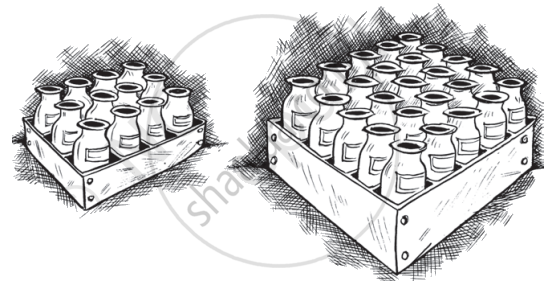
A batch of bottles was packed in 25 boxes with 12 bottles in each box. If the same batch is packed using 20 bottles in each box, how many boxes would be filled?
Two persons could fit new windows in house in 3 days.
One of the persons fell ill before the work started. How long would the job take now?
It x and y vary inversely, fill in the following blank:
| x | 9 | ... | 81 | 243 |
| y | 27 | 9 | ... | 1 |
A work-force of 420 men with a contractor can finish a certain piece of work in 9 months. How many extra men must he employ to complete the job in 7 months?
If x and y vary inversely as other and y = 35, find x when constant of variation = 7.
The stock of grain in a government warehouse lasts 30 days for 4000 people. How many days will it last for 6000 people?
12 cows can graze a field for 10 days. 20 cows can graze the same field for _______ days
When two quantities x and y are in ______ proportion or vary ______ they are written as `x oo 1/y`.
If x varies inversely as y and when x = 6, y = 8, then for x = 8 the value of y is 10.
