English
Karnataka Board PUCPUC Science Class 11

A Narrow Beam of Singly Charged Potassium Ions of Kinetic Energy 32 Kev is Injected into a Region of Width 1.00 Cm with a Magnetic Field of Strength 0.500 T, as - Physics

Advertisements
Advertisements

Question

A narrow beam of singly charged potassium ions of kinetic energy 32 keV is injected into a region of width 1.00 cm with a magnetic field of strength 0.500 T, as shown in the figure. The ions are collected at a screen 95.5 cm away from the field region. If the beam contains isotopes of atomic weights 39 and 41, find the separation between the points where these isotopes strike the screen. Take the mass of a potassium ion = A (1.6 × 10⁻²⁷) kg, where A is the mass number.
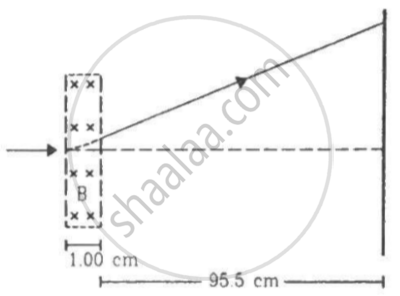
Sum
Advertisements

Solution

Kinetic energy of singly-charged potassium ions = 32 keV
Width of the magnetic region = 1.00 cm
Magnetic field's strength, B = 0.500 T
Distance between the screen and the region = 95.5 cm
Atomic weights of the two isotopes are 39 and 41.
Mass of a potassium ion = A (1.6 × 10⁻²⁷) kg
For a singly-charged potassium ion K-39 :
Mass of K-39 = 39 × 1.6 × 10−27 kg,
Charge, q = 1.6 × 10⁻¹⁹ C
As per the question, the narrow beam of singly-charged potassium ions is injected into a region of magnetic field.
As
K.E = 32 keV 
`1/2 mv^2 = 32 xx 10^3 xx 1.6 xx 10^-19`

 `1/2`× 39 × (1.6 × 10−27) × v2 = 32 × 103 × 1.6 × 10−19
v = 4.05 × 10⁵
We know that throughout the motion, the horizontal velocity remains constant.
So, the time taken to cross the magnetic field,
t = `d/v = (0.01)/(4.05xx10^5)` 
= 24.7 × 10⁻⁹ s
Now, the acceleration in the magnetic field region:
F = qvB = ma
`a = (qvB)/(m)`
= `(1.6xx10^-19xx4.05xx10^5)/(39xx1.6xx10^-27)`
= 5192 × 108 m/s2
Velocity in the vertical direction, vy  = at
= 5193.53 × 108 × 24.7 × 10−9
= 12824.24 m/s
Time taken to reach the screen
`d/v = (0.955)/(4.05xx10^5)`
Distance moved vertically in this time
= vy × t
= 12824.24 × 2358 × 10−9
= 3023.95×10-5 m
Vertical distance travelled by the particle inside magnetic field can be found out by using equaton of motion
v2 = 2aS
⇒ (12824.24)2 = 2 × 5192 × 108 × S
⇒ 15.83×10−5 = S
Net display from line
= 15.83×10⁻⁵+3023.95×10-5
= 3039.787×10−5 m.
For the potassium ion K-41l :
`1/2`× 41 × 1.6 × 10−27 v2= 32 × 103 × 1.6 × 10−9
⇒ v = 3.94×10m/s
Similarly, acceleration,
a = 4805 × 108 m/s2
t = time taken for exiting the magnetic field
= 25.4 × 10⁻⁹ sec.
vy1= at (vertical velocity)
= 4805 × 108 × 25.4 × 10−9
= 12204.7× 10−9 m/s
Time to reach the screen
= 2423× 10−9 s.

Distance moved vertically
= 12204.7 × 2423 × 10−9
= 2957.1× 10−5
Now,
Vertical distance travelled by the particle inside magnetic field can be found out by using equaton of motion
v2 = 2aS
 (12204.7)2 = 2 × 4805 × 108 S
⇒ S = 15.49× 10⁻⁵ m
Net distance travelled
= 15.49× 10⁻⁵ +2957.1× 10−5
= 2972.68× 10-5 m.
Net gap between K-39 and K-41
= 3039.787×10−5− 2972.68× 10-5
=  67 mm.

shaalaa.com
Force on a Moving Charge in Uniform Magnetic and Electric Fields
  Is there an error in this question or solution?
Chapter 12: Magnetic Field - Exercises [Page 233]

APPEARS IN

HC Verma Concepts of Physics Vol. 2 [English] Class 11 and 12
Chapter 12 Magnetic Field
Exercises | Q 42 | Page 233

RELATED QUESTIONS

A neutron, an electron and an alpha particle, moving with equal velocities, enter a uniform magnetic field going into the plane of the paper, as shown. Trace their paths in the field and justify your answer.


A proton and an α-particle move perpendicular to a magnetic field. Find the ratio of radii of circular paths described by them when both have (i) equal velocities, and (ii) equal kinetic energy. 


A straight wire of mass 200 g and length 1.5 m carries a current of 2 A. It is suspended in mid air by a uniform magnetic field B. What is the magnitude of the magnetic field?


Write the expression for Lorentz magnetic force on a particle of charge ‘q’ moving with velocity `vecv` in a magnetic field`vecB`. Show that no work is done by this force on the charged particle.


A beam consisting of protons and electrons moving at the same speed goes through a thin region in which there is a magnetic field perpendicular to the beam. The protons and the electrons


An electric current i enters and leaves a uniform circular wire of radius a through diametrically opposite points. A charged particle q, moving along the axis of the circular wire, passes through its centre at speed v. The magnetic force acting on the particle, when it passes through the centre, has a magnitude equal to


If a charged particle projected in a gravity-free room deflects, 
(a) there must be an electric field
(b) there must be a magnetic field
(c) both fields cannot be zero
(d) both fields can be non-zero


A charged particle moves in a gravity-free space without change in velocity. Which of the following is/are possible?
(a) E = 0, B = 0
(b) E = 0, B ≠ 0
(c) E ≠ 0, B = 0
(d) E ≠ 0, B ≠ 0


Consider three quantities  \[x = E/B,   y = \sqrt{1/ \mu_0 \epsilon_0}\] and \[z = \frac{l}{CR}\] . Here, l is the length of a wire, C is a capacitance and R is a resistance. All other symbols have standard meanings.

(a) xy have the same dimensions.
(b) yz have the same dimensions.
(c) zx have the same dimensions.
(d) None of the three pairs have the same dimensions.


A current of 2 A enters at the corner d of a square frame abcd of side 20 cm and leaves at the opposite corner b. A magnetic field B = 0.1 T exists in the space in a direction perpendicular to the plane of the frame, as shown in the figure. Find the magnitude and direction of the magnetic forces on the four sides of the frame.


A metal wire PQ of mass 10 g lies at rest on two horizontal metal rails separated by 4.90 cm (figure). A vertically-downward magnetic field of magnitude 0.800 T exists in the space. The resistance of the circuit is slowly decreased and it is found that when the resistance goes below 20.0 Ω, the wire PQ starts sliding on the rails. Find the coefficient of friction.


A current i is passed through a silver strip of width d and area of cross-section A. The number of free electrons per unit volume is n. (a) Find the drift velocity v of the electrons. (b) If a magnetic field B exists in the region, as shown in the figure, what is the average magnetic force on the free electrons? (c) Due to the magnetic force, the free electrons get accumulated on one side of the conductor along its length. This produces a transverse electric field in the conductor, which opposes the magnetic force on the electrons. Find the magnitude of the electric field which will stop further accumulation of electrons. (d) What will be the potential difference developed across the width of the conductor due to the electron-accumulation? The appearance of a transverse emf, when a current-carrying wire is placed in a magnetic field, is called Hall effect.


An electron of kinetic energy 100 eV circulates in a path of radius 10 cm in a magnetic field. Find the magnetic field and the number of revolutions per second made by the electron.


A circular coil of radius 2.0 cm has 500 turns and carries a current of 1.0 A. Its axis makes an angle of 30° with the uniform magnetic field of magnitude 0.40 T that exists in the space. Find the torque acting on the coil.


A narrow beam of singly-charged carbon ions, moving at a constant velocity of 6.0 × 10⁴m s−1, is sent perpendicularly in a rectangular region of uniform magnetic field B = 0.5 T (figure). It is found that two beams emerge from the field in the backward direction, the separations from the incident beam being 3.0 cm and 3.5 cm. Identify the isotopes present in the ion beam. Take the mass of an ion = A(1.6 × 10⁻²⁷) kg, where A is the mass number.


A particle with a charge of 5.0 µC and a mass of 5.0 × 10⁻¹² kg is projected with a speed of 1.0 km s−1 in a magnetic field of magnitude 5.0 mT. The angle between the magnetic field and the velocity is sin−1 (0.90). Show that the path of the particle will be a helix. Find the diameter of the helix and its pitch.


A particle of mass m and charge q is released from the origin in a region in which the electric field and magnetic field are given by
`vecB = -B_0 vecj and vecE = E_0 vecK `
Find the speed of the particle as a function of its z-coordinate.


Share
Notifications

Englishहिंदीमराठी


      Forgot password?
Use app×