मराठी
कर्नाटक बोर्ड पी.यू.सी.पीयूसी विज्ञान इयत्ता ११

A Narrow Beam of Singly Charged Potassium Ions of Kinetic Energy 32 Kev is Injected into a Region of Width 1.00 Cm with a Magnetic Field of Strength 0.500 T, as - Physics

Advertisements
Advertisements

प्रश्न

A narrow beam of singly charged potassium ions of kinetic energy 32 keV is injected into a region of width 1.00 cm with a magnetic field of strength 0.500 T, as shown in the figure. The ions are collected at a screen 95.5 cm away from the field region. If the beam contains isotopes of atomic weights 39 and 41, find the separation between the points where these isotopes strike the screen. Take the mass of a potassium ion = A (1.6 × 10⁻²⁷) kg, where A is the mass number.
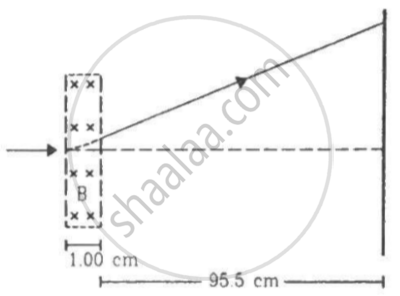
बेरीज
Advertisements

उत्तर

Kinetic energy of singly-charged potassium ions = 32 keV
Width of the magnetic region = 1.00 cm
Magnetic field's strength, B = 0.500 T
Distance between the screen and the region = 95.5 cm
Atomic weights of the two isotopes are 39 and 41.
Mass of a potassium ion = A (1.6 × 10⁻²⁷) kg
For a singly-charged potassium ion K-39 :
Mass of K-39 = 39 × 1.6 × 10−27 kg,
Charge, q = 1.6 × 10⁻¹⁹ C
As per the question, the narrow beam of singly-charged potassium ions is injected into a region of magnetic field.
As
K.E = 32 keV 
`1/2 mv^2 = 32 xx 10^3 xx 1.6 xx 10^-19`

 `1/2`× 39 × (1.6 × 10−27) × v2 = 32 × 103 × 1.6 × 10−19
v = 4.05 × 10⁵
We know that throughout the motion, the horizontal velocity remains constant.
So, the time taken to cross the magnetic field,
t = `d/v = (0.01)/(4.05xx10^5)` 
= 24.7 × 10⁻⁹ s
Now, the acceleration in the magnetic field region:
F = qvB = ma
`a = (qvB)/(m)`
= `(1.6xx10^-19xx4.05xx10^5)/(39xx1.6xx10^-27)`
= 5192 × 108 m/s2
Velocity in the vertical direction, vy  = at
= 5193.53 × 108 × 24.7 × 10−9
= 12824.24 m/s
Time taken to reach the screen
`d/v = (0.955)/(4.05xx10^5)`
Distance moved vertically in this time
= vy × t
= 12824.24 × 2358 × 10−9
= 3023.95×10-5 m
Vertical distance travelled by the particle inside magnetic field can be found out by using equaton of motion
v2 = 2aS
⇒ (12824.24)2 = 2 × 5192 × 108 × S
⇒ 15.83×10−5 = S
Net display from line
= 15.83×10⁻⁵+3023.95×10-5
= 3039.787×10−5 m.
For the potassium ion K-41l :
`1/2`× 41 × 1.6 × 10−27 v2= 32 × 103 × 1.6 × 10−9
⇒ v = 3.94×10m/s
Similarly, acceleration,
a = 4805 × 108 m/s2
t = time taken for exiting the magnetic field
= 25.4 × 10⁻⁹ sec.
vy1= at (vertical velocity)
= 4805 × 108 × 25.4 × 10−9
= 12204.7× 10−9 m/s
Time to reach the screen
= 2423× 10−9 s.

Distance moved vertically
= 12204.7 × 2423 × 10−9
= 2957.1× 10−5
Now,
Vertical distance travelled by the particle inside magnetic field can be found out by using equaton of motion
v2 = 2aS
 (12204.7)2 = 2 × 4805 × 108 S
⇒ S = 15.49× 10⁻⁵ m
Net distance travelled
= 15.49× 10⁻⁵ +2957.1× 10−5
= 2972.68× 10-5 m.
Net gap between K-39 and K-41
= 3039.787×10−5− 2972.68× 10-5
=  67 mm.

shaalaa.com
Force on a Moving Charge in Uniform Magnetic and Electric Fields
  या प्रश्नात किंवा उत्तरात काही त्रुटी आहे का?
पाठ 12: Magnetic Field - Exercises [पृष्ठ २३३]

APPEARS IN

एचसी वर्मा Concepts of Physics Vol. 2 [English] Class 11 and 12
पाठ 12 Magnetic Field
Exercises | Q 42 | पृष्ठ २३३

संबंधित प्रश्‍न

Write the expression for the force `vecF` acting on a particle of mass m and charge q moving with velocity `vecV` in a magnetic field `vecB` , Under what conditions will it move in (i) a circular path and (ii) a helical path?


A proton and an α-particle move perpendicular to a magnetic field. Find the ratio of radii of circular paths described by them when both have (i) equal velocities, and (ii) equal kinetic energy. 


An electron moving horizontally with a velocity of 4 ✕ 104 m/s enters a region of uniform magnetic field of 10−5 T acting vertically upward as shown in the figure. Draw its trajectory and find out the time it takes to come out of the region of magnetic 

field.


A straight wire of mass 200 g and length 1.5 m carries a current of 2 A. It is suspended in mid air by a uniform magnetic field B. What is the magnitude of the magnetic field?


Assume that the magnetic field is uniform in a cubical region and zero outside. Can you project a charged particle from outside into the field, so that the particle describes a complete circle in the field?


If a charged particle projected in a gravity-free room deflects, 
(a) there must be an electric field
(b) there must be a magnetic field
(c) both fields cannot be zero
(d) both fields can be non-zero


If a charged particle moves unaccelerated in a region containing electric and magnetic fields
(a) `vecE  "must be perpendicular" to vecB`
(b) `vecv "must be perpendicular" to vecE` 
(c) must be perpendicular to v_B


Consider three quantities  \[x = E/B,   y = \sqrt{1/ \mu_0 \epsilon_0}\] and \[z = \frac{l}{CR}\] . Here, l is the length of a wire, C is a capacitance and R is a resistance. All other symbols have standard meanings.

(a) xy have the same dimensions.
(b) yz have the same dimensions.
(c) zx have the same dimensions.
(d) None of the three pairs have the same dimensions.


A 10 g bullet with a charge of 4.00 μC is fired at a speed of 270 m s−1 in a horizontal direction. A vertical magnetic field of 500 µT exists in the space. Find the deflection of the bullet due to the magnetic field as it travels through 100 m. Make appropriate approximations.


A current i is passed through a silver strip of width d and area of cross-section A. The number of free electrons per unit volume is n. (a) Find the drift velocity v of the electrons. (b) If a magnetic field B exists in the region, as shown in the figure, what is the average magnetic force on the free electrons? (c) Due to the magnetic force, the free electrons get accumulated on one side of the conductor along its length. This produces a transverse electric field in the conductor, which opposes the magnetic force on the electrons. Find the magnitude of the electric field which will stop further accumulation of electrons. (d) What will be the potential difference developed across the width of the conductor due to the electron-accumulation? The appearance of a transverse emf, when a current-carrying wire is placed in a magnetic field, is called Hall effect.


A proton describes a circle of radius 1 cm in a magnetic field of strength 0.10 T. What would be the radius of the circle described by an α-particle moving with the same speed in the same magnetic field?


A narrow beam of singly-charged carbon ions, moving at a constant velocity of 6.0 × 10⁴m s−1, is sent perpendicularly in a rectangular region of uniform magnetic field B = 0.5 T (figure). It is found that two beams emerge from the field in the backward direction, the separations from the incident beam being 3.0 cm and 3.5 cm. Identify the isotopes present in the ion beam. Take the mass of an ion = A(1.6 × 10⁻²⁷) kg, where A is the mass number.


The figure shows a convex lens of focal length 12 cm lying in a uniform magnetic field Bof magnitude 1.2 T parallel to its principal axis. A particle with charge 2.0 × 10⁻³ C  and mass 2.0 × 10⁻⁵ kg is projected perpendicular to the plane of the diagram with a speed of 4.8 m s−1. The particle moves along a circle with its centre on the principal axis at a distance of 18 cm from the lens. Show that the image of the particle moves along a circle and find the radius of that circle.


A uniform magnetic field of magnitude 0.20 T exists in space from east to west. With what speed should a particle of mass 0.010 g and with charge 1.0 × 10⁻⁵ C be projected from south to north so that it moves with uniform velocity?


A particle with a charge of 5.0 µC and a mass of 5.0 × 10⁻¹² kg is projected with a speed of 1.0 km s−1 in a magnetic field of magnitude 5.0 mT. The angle between the magnetic field and the velocity is sin−1 (0.90). Show that the path of the particle will be a helix. Find the diameter of the helix and its pitch.


A proton projected in a magnetic field of 0.020 T travels along a helical path of radius 5.0 cm and pitch 20 cm. Find the components of the velocity of the proton along and perpendicular to the magnetic field. Take the mass of the proton = 1.6 × 10⁻²⁷ kg


A long, straight wire carrying a current of 30 A is placed in an external, uniform magnetic field of 4.0 × 10⁻⁴ T parallel to the current. Find the magnitude of the resultant magnetic field at a point 2.0 cm away from the wire.


Two parallel circular coils of equal radii having equal number of turns placed coaxially and separated by a distance equal to the radii of the coils carrying equal currents in same direction are known as ______.

Current flows through uniform, square frames as shown in the figure. In which case is the magnetic field at the centre of the frame not zero?


A particle of mass 10 mg and having a charge of 50 mC is projected with a speed of 15 m/s into a uniform magnetic field of 125 mT. Assuming that the particle is projected with its velocity perpendicular to the magnetic field, the time after which the particle reaches its original position for the first time is ______.


Share
Notifications

Englishहिंदीमराठी


      Forgot password?
Use app×