Advertisements
Advertisements
Question
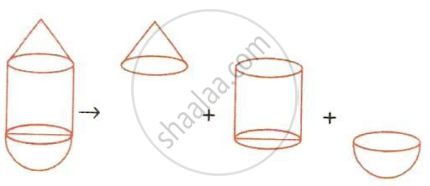
A metallic solid cylinder has one end surmounted by a cone of the same radius and a hemisphere, which is also of same radius at that of cone. The conical portion, the cylindercal portion and the hemispherical portion are separated as shown below:
If the radius of the given solid is r cm and the height of the cone = the height of the cylinder = h cm, find expression for the the total surface area of the three parts obtained.
Advertisements
Solution
When the three portions are separated, each becomes a complete solid. So, we add the entire surface area of the cone, the cylinder and the hemisphere.
For the cone:
Radius = r cm and height = h cm.
Slant height (l) = `sqrt (h^2+r^2)` cm.
Total surface area of cone = πrl + πr2 = `sqrt (h^2+r^2)` + πr2.
For the cylinder:
Radius = r cm and height = h cm.
Total surface area of cylinder = 2πrh + 2πr2
For the hemisphere:
Radius = r cm.
Total surface area of hemisphere = 2πr2 + πr2 = 3πr2
∴ Total surface area of the three parts
= `(πr sqrt (h^2+r^2) + πr^2) + (2πrh + 2πr^2) + 3πr^2`
= `πr sqrt (h^2+r^2) + 2πrh + 6πr^2`
= `πr sqrt (h^2+r^2)+2h+6r)`
Hence, total surface area of the three parts = `πr sqrt (h^2+r^2)+2h+6r)`.
