Advertisements
Advertisements
Question
A man raises a box of mass 50 kg to a height of 2 m in 20s, while another man raises the same box to the same height in 50s. Calculated:
- the work done, and
- the power developed by each man. Take g = 10 N kg-1.
Advertisements
Solution
(i) Work done by each man = mgh
= 50 × 10 × 2
= 1000 J
(ii) Work done in first case = `w/t_1`
= `1000/20`
= 50 W
Work done in second case = `w/t_2`
= `1000/50`
= 20 W
APPEARS IN
RELATED QUESTIONS
If the power of a motor is 100 kW, at what speed can it raise a load of 50,000 N?
When a body is placed on a table top, it exerts a force equal to its weight downwards on the table top but does not move or fall
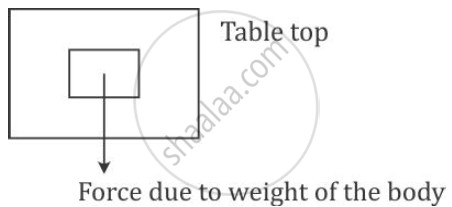
1) Name the force exerted by the table top
2) What is the direction of the force?
State and define the S.I. unit of work.
State two factors on which power spent by a source depends. Explain your answer with examples.
An ox can apply a maximum force of 1000 N. It is taking part in a cart race and is able to pull the cart at a constant speed of 30 ms-1 while making its best effort. Calculate the power developed by the ox.
In which one of the following cases is the work done more? When the angle between the direction of motion and that of the force is (i) 90° (ii) 0°.
A boy takes 3 minutes to lift a 20 litre water bucket from a 20 m deep well, while his father does it in 2 minutes.
How much work each does? Take density of water = 103 kg m-3 and g = 9.8 N kg-1.
Give the units of couple.
