Advertisements
Advertisements
Question
A ladder 17 metre long is leaning against the wall. The base of the ladder is pulled away from the wall at a rate of 5 m/s. When the base of the ladder is 8 metres from the wall. How fast is the top of the ladder moving down the wall?
Advertisements
Solution
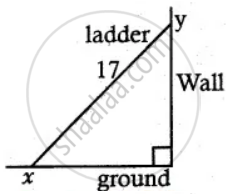
Let the height of the wall where the ladder touches are ‘y’ m.
The bottom of the ladder is at a distance of ‘x’ m from the wall.
Given x = 8, `("d"x)/"dt"` = 5
x2 + y2 = 172
Pythagoras Theorem
y2 = 172 – x2
= 289 – 64
= 225
∴ y = 15
Differentiating w.r.t. ‘t’
`2x ("d"x)/"dt" + 2y ("d"y)/"dt"` = 0 .....(÷ 2)
`x ("d"x)/"dt" + y ("d"y)/"dt"` = 0
`8(5) + 15 ("d"y)/"dt"` = 0
∴ `("d"y)/"dt" = 40/15`
= `- 8/5`
The top of the ladder is moving down the wall at the rate of `8/3` m/sec
APPEARS IN
RELATED QUESTIONS
A particle moves along a straight line in such a way that after t seconds its distance from the origin is s = 2t2 + 3t metres. Find the average velocity between t = 3 and t = 6 seconds
A particle moves along a straight line in such a way that after t seconds its distance from the origin is s = 2t2 + 3t metres. Find the instantaneous velocities at t = 3 and t = 6 seconds
A particle moves along a line according to the law s(t) = 2t3 – 9t2 + 12t – 4, where t ≥ 0. Find the particle’s acceleration each time the velocity is zero
If the mass m(x) (in kilograms) of a thin rod of length x (in metres) is given by, m(x) = `sqrt(3x)` then what is the rate of change of mass with respect to the length when it is x = 3 and x = 27 metres
A ladder 17 metre long is leaning against the wall. The base of the ladder is pulled away from the wall at a rate of 5 m/s. When the base of the ladder is 8 metres from the wall, at what rate, the area of the triangle formed by the ladder, wall, and the floor, is changing?
A police jeep, approaching an orthogonal intersection from the northern direction, is chasing a speeding car that has turned and moving straight east. When the jeep is 0.6 km north of the intersection and the car is 0.8 km to the east. The police determine with a radar that the distance between them and the car is increasing at 20 km/hr. If the jeep is moving at 60 km/hr at the instant of measurement, what is the speed of the car?
Find the points on curve y = x3 – 6x2 + x + 3 where the normal is parallel to the line x + y = 1729
Find the points on the curve y2 – 4xy = x2 + 5 for which the tangent is horizontal
Find the tangent and normal to the following curves at the given points on the curve
y = x2 – x4 at (1, 0)
Find the tangent and normal to the following curves at the given points on the curve
x = cos t, y = 2 sin2t at t = `pi/2`
Find the equations of the tangents to the curve y = 1 + x3 for which the tangent is orthogonal with the line x + 12y = 12
Find the angle between the rectangular hyperbola xy = 2 and the parabola x2 + 4y = 0
Show that the two curves x2 – y2 = r2 and xy = c2 where c, r are constants, cut orthogonally
Choose the correct alternative:
The position of a particle moving along a horizontal line of any time t is given by s(t) = 3t2 – 2t – 8. The time at which the particle is at rest is
Choose the correct alternative:
Find the point on the curve 6y = x3 + 2 at which y-coordinate changes 8 times as fast as x-coordinate is
Choose the correct alternative:
The abscissa of the point on the curve f(x) = `sqrt(8 - 2x)` at which the slope of the tangent is – 0.25?
Choose the correct alternative:
The tangent to the curve y2 – xy + 9 = 0 is vertical when
Choose the correct alternative:
The maximum slope of the tangent to the curve y = ex sin x, x ∈ [0, 2π] is at
