Advertisements
Advertisements
Questions
A human female experiences two major changes, menarche and menopause during her life. Mention the significance of both the events.
Women experiences two major events in their life time one at menarche and the second at menopause. Mention the characteristics of both the events.
Advertisements
Solution
Menarche:
- It is the first menstrual flow in a girl’s life.
- Occurs between age 11 to 13 years.
- Marks the beginning of reproductive phase.
- Indicates onset of puberty and ovulation begins.
Menopause:
- It is the permanent cessation of menstrual cycles.
- Occurs between age 45 to 50 years.
- Ovarian follicles stop responding to pituitary hormones.
- Ovulation and menstruation cease; fertility ends.
- Estrogen levels fall, causing physical and psychological changes.
APPEARS IN
RELATED QUESTIONS
Identify True/False statement. Correct false statement to make it true.
Menstrual cycle ceases during pregnancy.
The Graafian follicle, after ovulation turns into a hormone producing issue called Corpus callosum.
Give appropriate biological or technical terms for the following:
The onset of menstruation in a young girl
Define the following term :
Ovulation
Give appropriate terms for each of the following process:
Fixing of developing zygote (blastocyst) on the uterine wall.
Explain the ovarian cycle with its different phases.
Explain the importance of cleanliness during the time of menstrual cycle in girls.
Read the following passage and answer the question that follows:
Rahini and her parents were watching a television program. An advertisement flashed on the screen which was promoting the use of sanitary napkins. Rahini’s parents suddenly changed the channel, but she objected to her parents and explained the need and importance of such an advertisement.
Do you think that Rahini’s objection towards her parents was correct? If so, Why?
What are the phases of the menstrual cycle? Indicate the changes in the ovary and uterus.
The following is the illustration of the sequence of ovarian events (a-i) in a human female.
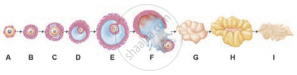
Name the ovarian hormone and the pituitary hormone that have caused the above-mentioned events.
Which one of the following events occurs during the secretory phase of the menstrual cycle?
When does the following step take place?

The correct sequence of hormone secretion from the beginning of menstruation is ______.
Immediately after ovulation, the mammalian egg is covered by a membrane known as ______.
Which set is similar?
Corpus luteum ______.
Which one of the following statements is incorrect about menstruation?
Which of the following events is not associated with ovulation in human females?
About which day in a normal human menstrual cycle does rapid secretion of LH (Popularly called LH Surge) normally occurs?
At which stage of the menstrual cycle, both LH and FSH are high?
The level of progesterone is high at which phase in the menstrual cycle?
What role does pituitary gonadotropins play during follicular and ovulatory phases of menstrual cycle? Explain the shifts in steroidal secretions.
In the figure given below, parts A and B show the level of hormones which influence the menstrual cycle. Study the figure and answer the questions that follow:
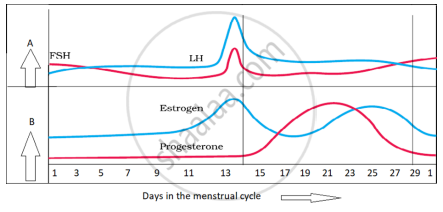
- Name the organs which secrete the hormones represented in parts A and B.
- State the impact of the hormones in part B on the uterus of the human female during 6 to 15 days of the menstrual cycle.
Spermatogenesis is induced by ______.
Write a short note on Secretory Phase.
Given below is the diagram depicting the menstrual cycle in human beings. Study it carefully and answer the questions that follow.

- Which phases are indicated by ‘C’ and ‘D’?
- Name the structures labelled ‘F’. What is its role?
- Explain the changes in the level of progesterone during phases ‘C’ and ‘D’.
- Which hormone present in the urine confirms pregnancy in human beings?
- Identify the structure labelled ‘E’. Name the hormone released by it.
Complete the following table by writing the name of the structure or the function of the given structure:
| Structure | Function | ||
| 1. | Corpus luteum | 1. | ______ |
| 2. | ______ | 2. | Produces male gametes in mass |
| 3. | Leydig cells | 3. | ______ |
| 4. | ______ | 4. | Stores the sperms until they mature and become mobile |
| 5. | Umbilical cord | 5. | ______ |
| 6. | Fallopian tube | 6. | ______ |
Which of the following statements are correct regarding female reproductive cycle?
- In non-primate mammals cyclical changes during reproduction are called oestrus cycle.
- First menstrual cycle begins at puberty and is called menopause.
- Lack of menstruation may be indicative of pregnancy.
- Cyclic menstruation extends between menarche and menopause.
Choose the most appropriate answer from the options given below:
