Advertisements
Advertisements
Question
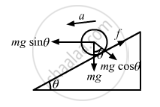
A hollow sphere is released from the top of an inclined plane of inclination θ. (a) What should be the minimum coefficient of friction between the sphere and the plane to prevent sliding? (b) Find the kinetic energy of the ball as it moves down a length l on the incline if the friction coefficient is half the value calculated in part (a).
Advertisements
Solution
It is given that a hollow sphere is released from the top of an inclined plane of inclination θ.
(a) To prevent sliding, the body will make only perfect rolling. In this condition, we have
\[mgl \sin \theta - f = ma............(1)\]
\[f \times R = \left( \frac{2}{3} \right) m R^2 \times \left( \frac{a}{R} \right)\]
\[ \Rightarrow f = \frac{2}{3} ma...........(2)\]
On putting this value in the equation (1), we get
\[mg \sin \theta - \frac{2}{3} ma = ma\]
\[\Rightarrow a = \frac{3}{5} g \sin \theta\]
From equation (1), we have
\[mg \sin \theta - f = \frac{3}{5} mg \sin \theta\]
\[ \Rightarrow f = \frac{2}{5} mg \sin \theta\]
\[ \Rightarrow \mu mg \cos \theta = \frac{2}{5} mg \sin\theta\]
\[ \Rightarrow \mu = \frac{2}{5} \tan \theta\]
(b)
\[\left( \frac{1}{5} \right) \tan \theta \left( mg \cos \theta \right) R = \frac{2}{3} m R^2 \alpha\]
\[ \Rightarrow \alpha = \frac{3}{10} \left( \frac{g \sin \theta}{R} \right)\]
\[a_c = g \sin \theta - \left( \frac{g}{5} \right) \sin \theta\]
\[ = \left( \frac{4}{5} \right) g \sin \theta\]
\[ \Rightarrow t^2 = \frac{2l}{a_c}\]
\[= 2l \left( 4g\frac{\sin \theta}{5} \right) \left( \frac{5}{2g \sin \theta} \right)\]
\[\therefore \omega = at \]
\[ K . E . = \frac{1}{2} m \nu^2 + \frac{1}{2} I \omega^2 \]
\[ = \frac{1}{2} m \left( 2al \right) + \frac{1}{2} l \left( a^2 t^2 \right)\]
\[ = \frac{1}{2} m \left( 4g \frac{\sin \theta}{5} \right) \times 2 \times l + \frac{1}{2} \times \frac{2}{3} m R^2 \times \frac{9}{100}\]
\[ = \left( \frac{\sin^2 \theta}{R} \right) \times \left( \frac{5L}{2g \sin \theta} \right)\]
\[ = 4 mgl \frac{\sin \theta}{5} + 3 mgl \frac{\sin \theta}{40}\]
\[ = \frac{7}{8} mgl \sin \theta\]
APPEARS IN
RELATED QUESTIONS
A solid sphere rolls down two different inclined planes of the same heights but different angles of inclination. (a) Will it reach the bottom with the same speed in each case? (b) Will it take longer to roll down one plane than the other? (c) If so, which one and why?
A solid sphere of mass 1 kg rolls on a table with linear speed 2 m/s, find its total kinetic energy.
Answer in Brief:
A rigid object is rolling down an inclined plane derive the expression for the acceleration along the track and the speed after falling through a certain vertical distance.
A pendulum consisting of a massless string of length 20 cm and a tiny bob of mass 100 g is set up as a conical pendulum. Its bob now performs 75 rpm. Calculate kinetic energy and increase in the gravitational potential energy of the bob. (Use π2 = 10)
What is the difference between sliding and slipping?
Discuss rolling on an inclined plane and arrive at the expression for acceleration.
A uniform disc of mass 100g has a diameter of 10 cm. Calculate the total energy of the disc when rolling along with a horizontal table with a velocity of 20 cms-1. (take the surface of the table as reference)
A solid sphere rolls down from top of inclined plane, 7m high, without slipping. Its linear speed at the foot of plane is ______. (g = 10 m/s2)
A man is supported on a frictionless horizontal surface. It is attached to a string and rotates about a fixed centre at an angular velocity `omega`. The tension in the strings is F. If the length of string and angular velocity are doubled, the tension in string is now ____________.
A solid sphere is rolling on a frictionless surface with translational velocity 'V'. It climbs the inclined plane from 'A' to 'B' and then moves away from Bon the smooth horizontal surface. The value of 'V' should be ______.

The angular velocity of minute hand of a clock in degree per second is ______.
A solid spherical ball rolls on an inclined plane without slipping. The ratio of rotational energy and total energy is ______.
The least coefficient of friction for an inclined plane inclined at angle α with horizontal in order that a solid cylinder will roll down without slipping is ______.
The kinetic energy and angular momentum of a body rotating with constant angular velocity are E and L. What does `(2E)/L` represent?
The angular displacement of a particle in 6 sec on a circle with angular velocity `pi/3` rad/sec is ______.
A disc of mass 4 kg rolls on a horizontal surface. If its linear speed is 3 m/ s, what is its total kinetic energy?
