Advertisements
Advertisements
Question
A fruit seller purchased 20 kg of apples at ₹ 50 per kg. Out of these, 5% of the apples were found to be rotten. If he sells the remaining apples at ₹ 60 per kg, then his ______ is ______%.
Advertisements
Solution
A fruit seller purchased 20 kg of apples at ₹ 50 per kg. Out of these, 5% of the apples were found to be rotten. If he sells the remaining apples at ₹ 60 per kg, then his profit is 14%.
Explanation:
We have, price for per kg apples = ₹ 50
Total purchased apples = 20 kg
Since, 5% were rotten, so good apples = 20 kg – 5% of 20 kg (rotten)
= `20 - 5/100 xx 20`
= 20 – 1
= 19 kg
Also, he sells 19 kg apples at ₹ 60 per kg
∴ Total selling price = 19 × 60 = ₹ 1140
∵ Cost price was 20 kg apples = 20 × 50 = ₹ 1000
∴ Profit = SP – CP = 1140 – 1000 = ₹ 140
Now, profit % = `"Profit"/"CP" xx 100%`
= `140/1000 xx 100%`
= `140/10`
= 14%
So, his profit is 14%.
APPEARS IN
RELATED QUESTIONS
A man sells an article at a profit of 25%. If he had bought it at 20% less and sold it for Rs 36.75 less, he would have gained 30%. Find the cost price of the article.
Some toffees are bought at the rate of 11 for Rs 10 and the same number at the rate of 9 for Rs 10. If the whole lot is sold at one rupee per toffee, find the gain or loss percent on the whole transaction.
On the eve of Gandhi Jayanti a saree is sold for Rs 720 after allowing 20% discount. What is its marked price?
Abraham bought goods worth Rs 50000 and spent Rs 7000 on transport and octroi. If he sold the goods for Rs 65000, did he make a profit or a loss? How much?
An electrician buys a used T.V. for ₹ 12,000 and a used Fridge for ₹ 11,000. After spending ₹ 1000 on repairing the T.V. and ₹ 1500 on painting the Fridge, he fixes up the M.P. of T.V. as ₹ 15,000 and that of Fridge as ₹ 15,500. If he gives ₹ 1000 discount on each find his profit or loss
C.P. = M.P. – Discount.
Lemons were bought at Rs 48 per dozen and sold at the rate of Rs 40 per 10. Find the gain or loss per cent.
Music CD originally priced at Rs 120 is on sale for 25% off. What is the S.P.?
Sonia and Rahul have different ways of calculating the sale price for the items they bought.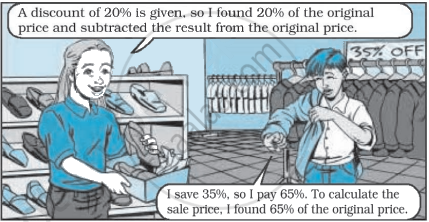
As you work on the next problem, try both of these methods to see which you prefer.
Nasim bought a pen for ₹ 60 and sold it for ₹ 54. His ______ % is ______.
