Advertisements
Advertisements
Question
A current carrying solenoid behaves like a ______.
Advertisements
Solution
A current carrying solenoid behaves like a bar magnet.
APPEARS IN
RELATED QUESTIONS
Draw a diagram to represent the magnetic field lines along the axis of a current carrying solenoid. Mark arrows to show the direction of current in the solenoid and the direction of magnetic field lines.
How is the magnetic field due to a solenoid carrying current affected if a soft iron bar is introduced inside the solenoid?
Draw the pattern of magnetic field lines of a solenoid through which a steady current flows. What does the pattern of field lines inside the solenoid indicate?
What is a solenoid? Why do we usually keep its diameter small in comparison to its length?
The factors on which one magnetic field strength is produced by current-carrying solenoids depends are
The diagram below shows an insulated copper wire wound around a hollow cardboard cylindrical tube. Answer the questions that follow:
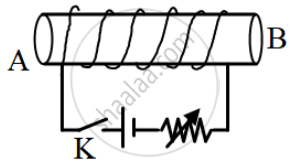
- What are the magnetic poles at A and B when the key K is closed?
- State two ways to increase the strength of the magnetic field in this coil without changing the coil.
- If we place a soft iron bar at the centre of the hollow cardboard and replace the DC source with an AC source then will it attract small iron pins toward itself when the current is flowing through the coil?
A circuit contains a battery, a variable resistor and a solenoid. The figure below shows the magnetic field pattern produced by the current in the solenoid.
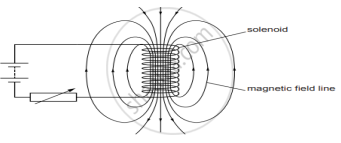
- State how the magnetic field pattern indicates regions where the magnetic field is stronger.
- What happens to the magnetic field when the current in the circuit is reversed?
When does a solenoid behave as a magnet? Draw the pattern of the magnetic field produced inside it showing the directions of the magnetic field lines.
Refer to the image below and state how the magnetic field pattern indicates regions where the magnetic field is stronger outside the magnet. What happens to the magnetic field when the current in the circuit is reversed?

Draw a neat diagram of a solenoid and name its various components.
