Advertisements
Advertisements
Question
A consumer uses 4 lamps of 60 watt, 2 lamps of 40 watt, and 2 lamps of 100 watt. All these are used for 6 hour daily. Find the total bill for 30 days when the rate of energy is 75 paise per unit and the meter rent is Rs. 1.
Advertisements
Solution
Total power consumption of 4 lamps of 60 watt each = 60 × 4 = 240 W
Total power consumption of 2 lamps of 40 watt each = 40 × 2 = 80 W
Total power consumption of 2 lamps of 100 watt each = 100 × 2 = 200 W.
∴ Total power consumption = (240 + 80 + 200) = 520 W
∴ Total watt-hour for 6 hours a day for 30 days = 520 × 6 × 30 = 93600 watt-hour
Hence, kilowatt-hour =`93600/1000 = 93.6` kWh
Cost of electric energy at 75 p.per kWh =`(93.6 xx 75)/100 = 70.20`
∴ Total cost = Rs. 70.20 + Rs. 1.0 (Meter rent)
= Rs. 71.20
RELATED QUESTIONS
An electric lamp is labelled 12 V, 36 W. This indicates that it should be used with a 12 V supply. What other information does the label provide?
What is meant by "electric power"?
An immersion heater rated 1000 W, 220 V is used to heat 0.01 m3 of water. Assuming that the power is supplied at 220 V and 60% of the power supplied is used to heat the water, how long will it take to increase the temperature of the water from 15°C to 40°C?
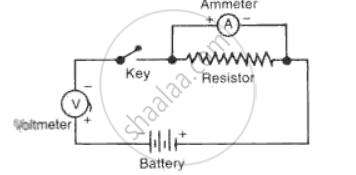
What is wrong with the circuit diagram (Fig. 34)? Carefully check the symbols and assign proper positive and negative signs to them.
‘The current rating of a fuse is 5A’. Comment on this statement.
Which material is the calorimeter commonly made of? Give one reason for using this material.
How is the amount of heat produced calculated due to the passage of current in a metallic conductor? Derive an expression for it.
The resistance of filament of an electric heater is 500 Ω It is operated at 200V for 1 hour daily. Calculate the current drawn by the heater and the energy consumed in joule.
An electrical appliance is rated 1500 W, 250 V. This appliance is connected to 250 V mains. Calculate:
(i) the current drawn,
(ii) the electrical energy consumed in 60 hours,
(iii) the cost of electrical energy consumed at Rs. 2.50 per kWh.
A electric bulb is rate 220 V, 60 W. its electric cell resistance is nearly
