Advertisements
Advertisements
Question
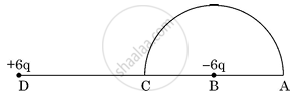
A charge −6 μC is placed at the centre B of a semicircle of radius 5 cm, as shown in the figure. An equal and opposite charge is placed at point D at a distance of 10 cm from B. A charge +5 μC is moved from point ‘C’ to point ‘A’ along the circumference. Calculate the work done on the charge.
Advertisements
Solution
Central charge at B (qB) = −6 μC = −6 × 10⁻⁶ C
Charge at D (qD) = +6 μC = +6 × 10⁻⁶ C
Moving charge (q) = +5 μC = +5 × 10⁻⁶ C
Semicircle radius (r) = 5 cm = 0.05 m
The points are arranged horizontally in the order D, C, B, and A.
Distance from B to C (BC) = r = 0.05 m
Distance from B to A (BA) = r = 0.05 m
Distance from D to B (DB) = 10 cm = 0.10 m
Distance from D to C (DC) = DB − BC = 0.10 − 0.05 = 0.05 m
Distance from D to A (DA) = DB + BA = 0.10 + 0.05 = 0.15 m
Both points C and A lie on the circumference.
They are equidistant from the centre B.
VB,A = VB,C = `(k * q_B)/r`
Therefore, their potential difference due to qB is zero.
VB,A − VB,C = 0
Using Coulomb’s constant:
k = 9 × 10⁹ N . m2/C2
The potentials at A and C caused by qD:
VD,A = `(k * q_D)/(DA)`
= `(9 xx 10^9 xx 6 xx 10^-6)/0.15`
= 3.6 × 10⁵ V
VD,C = `(k * q_D)/(DC)`
= `(9 xx 10^9 xx 6 xx 10^-6)/0.05`
= 1.08 × 10⁶ V
The net potential difference (ΔV) between the final point A and the initial point C is:
ΔV = VA − VC
= (VB,A − VB,C) + (VD,A − VD,C)
= 0 + 3.6 × 10⁵ − 1.08 × 106
= −7.2 × 10⁵ V
The work done on the moving charge is given by:
W = q . ΔV
= (5 × 10⁻⁶) × (−7.2 × 10⁵)
= −3.6 J
