Advertisements
Advertisements
Question
A proton moving with velocity `vec V` in a non-uniform magnetic field traces a path as shown in the figure.
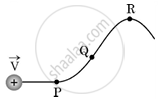
The path followed by the proton is always in the plane of the paper. What is the direction of the magnetic field in the region near points P, Q and R? What can you say about relative magnitude of magnetic fields at these points?
Advertisements
Solution
The Lorentz force in a magnetic field affects the path of a proton, a positively charged particle. In a magnetic field, the force acting on a charged particle is determined by:
`vec F = q(vec v xx vec B)`
The particle travels in a curved path because the force is always perpendicular to its velocity. The direction and fluctuations of the magnetic field are indicated by the curvature of the field. The proton travels along a curved path that remains in the plane of the paper.
This implies that the proton’s velocity in the plane is perpendicular to the force exerted on it. Because the proton curves upward, the force must be directed toward the center of curvature, which means that the magnetic field is always in the paper’s plane according to the right-hand rule.
The magnetic field is thus driven into the paper at locations P, Q, and R.
The following formula provides the radius of curvature (r) of the motion of a charged particle in a magnetic field:
r = `(mv)/(qB)`
A bigger radius results in a weaker magnetic field. The magnetic field is stronger when the radius is smaller.
Observing the trajectory:
- At P, the path is relatively straight, meaning B is smaller.
- At Q, the curvature increases, meaning B is increasing.
- At R, the curvature is highest, meaning B is largest. Hence, the relative magnitudes indicate that BP is smaller than BQ, and BR is greater than BQ.
