Advertisements
Advertisements
Question
A certain couple got four daughters in a sequence and no son. Does it mean that the husband does not produce Y-chromosome bearing sperms? Explain. What is the chance of this couple having a daughter?
Advertisements
Solution
Daughter or son is a matter of chance for Y- or X-chromosome carrying sperm to fertilize the egg. It is always 50% The couple got four daughters as a matter of chance encounter of the X-chromosome carrying sperm fertilizing the eggs. The chance of the couple getting another daughter is again 50% (so is for the son).
RELATED QUESTIONS
Given below are the F2 – phenotypic ratios of two independently carried monohybrid crosses :
(i) 1 : 2 : 1
(ii) 3 : 1
Mention what does each ratio suggest.
Answer the following question.
Write the basis on which Alfred Sturtevant explained gene mapping.
Give reasons why acquired characters are not inherited.
Cross between hybrid and recessive parent:
In a monohybrid cross of plants with red and white flowered plants, Mendel got only red-flowered plants. On self-pollinating these F1 plants got both red and white flowered plants in 3:1 ratio. Explain the basis of using RR and rr symbols to represent the genotype of plants of parental generation.
Assertion (A): In humans, if gene (B) is responsible for black eyes and gene (b) responsible for brown eyes, then the colour of eyes of the progeny having gene combination Bb, bb or BB will be black only.
Reason (R): The black colour of the eyes is a dominant trait.
Given below is a schematic representation of the inheritance of the shape of the seeds of garden peas. Answer the questions that follow:
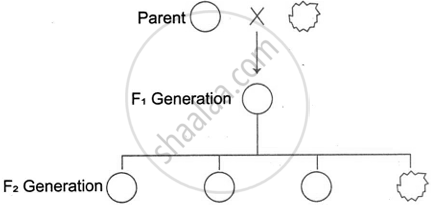
- Which is the dominant and recessive allele of the trait?
- What does the ratio 3 : 1 in the F2 generation represent?
- State Mendel's Law of Dominance.
In the first filial generation, what is the observation for the cross \[TT \times tt\]?
Which self-pollination is performed to obtain the F2 generation?
What are the four genotypic outcomes of the cross \[Tt \times Tt\]?
