Advertisements
Advertisements
Question
A bulb is marked 100W, 220V and an electric heater is marked 2000 W, 220 V.
(i) What is the ratio between the resistances of these two devices?
(ii) How does the power-voltage rating of a device help us to decide about the type of leads (connecting wires) to be used for it?
(iii) In which of the above two devices, a thicker connecting wire of lead is required?
Advertisements
Solution
(i) For bulb, let R1 be the resistance of its filament wire
P = V × I or W = V × I
100 = 200 × I = `(220 xx "V")/"R"_1 = (220 xx 220)/"R"_1`
∴ R1 = `(220 xx 220)/100` Ω = 484 Ω
For heater, let its resistance be R2
`2000 = 220 xx "I" = (220 xx 220)/"R"_2`
∴ R2 = `(220 xx 220)/2000` Ω = 24.2 Ω
i.e., R1 : R2 = 20 : 1
(ii) In the case of bulb current I1 = `"W"/"V" = 100/200 = 5/11` A = 0.45 A
We have (i) and (ii)
In the case of heater current =`"W"/"V" = 2000/220` = 9.09 A.
Hence power-voltage rating help us in this case. The current through the bulb is only 0.45 A while through the heater it is 9.09 A. Hence a heavy lead (to avoid power loss due to heating effect) is needed for the heater which for a bulb an ordinary thin connecting wire is required.
(iii) Electric heater requires a thicker wire of lead.
APPEARS IN
RELATED QUESTIONS
An electric bulb is rated at 220 V, 100 W. What is its resistance?
An electric kettle connected to the 230 V mains supply draws a current of 10 A. Calculate:
(a) the power of the kettle.
(b) the energy transferred in 1 minute.
Write an expression for the electrical power spent in flow of current through a conductor in terms of
(a) Resistance and potential difference, (b) current and resistance.
A servo voltage stabiliser restricts the voltage output to 220 V ± 1%. If an electric bulb rated at 220 V, 100 W is connected to it, what will be the minimum and maximum power consumed by it?
The diagram below shows a magnetic kept just below the conductor AB which is kept in North South direction.
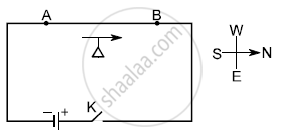
(i) In which direction will the needle deflect when the key is closed ?
(ii) Why is the deflection produced ?
(iii) What will be the change in the deflection if the magnetic needle is taken just above the conductor AB ?
(iv) Name one device which works on this principle.
What changes in energy occur in an electric heater?
An electric kettle is rated 3kW, 250V. What should be the current capacity of the fuse with it?
A family uses a light bulb of 100W, a fan of 100W, and a heater of 1000W, each for 8 hours a day. If the cost of electricity is Rs. 2 per unit, what is the expenditure to the family per day, on electricity?
Find the cost of operating an electric toaster for two hours if it draws 8 A current on a 110 volt circuit. The cost of electrical energy is Rs. 2.50 per kWh.
