Advertisements
Advertisements
Question
A bomb is dropped from a plane flying horizontally with uniform speed. Show that the bomb will explode vertically below the plane. Is the statement true if the plane flies with uniform speed but not horizontally?
Advertisements
Solution
The plane is flying horizontally with a uniform speed. Therefore, the bomb also has the same speed.
Let the speed of the plane be represented by u.
Now, let t be the time taken by the bomb to reach the ground.
Distance travelled by the bomb in horizontal direction = ut
Both the plane and bomb are travelling in the same direction.
Distance travelled by the plane in the same time = ut
Hence, the bomb will explode vertically below the plane.
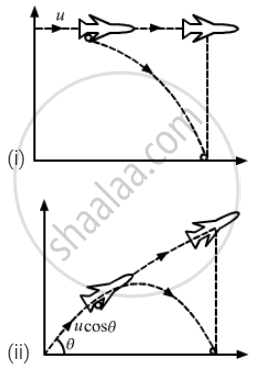
When the plane is flying with a uniform speed but not horizontally:
Let us consider it will make an angle of projection θ along the horizontal direction.
So, both the plane and the bomb will be flying with the same angle of projection.
Therefore, both will have the same horizontal speed u cos θ, where u is the initial speed of the plane and the bomb.
When the bomb is released, the time taken by the bomb to reach the ground is t.
The distance travelled by the bomb and the plane will be u cos θt.
Hence, again the bomb will explode vertically below the plane.
(i) During the motion of bomb, its horizontal velocity u remains constant and is the same as that of the plane at every point of its path.
Let the bomb reach the ground in time t.
Distance travelled in horizontal direction by the bomb = ut
Distance travelled in horizontal direction by the bomb is the same as that travelled by the plane.
So, the bomb will explode vertically below the plane.
(ii) Let the plane move making an angle α with the horizontal.
Horizontal distance for both the bomb and the plane = u cos αt'
t' = Time taken by the bomb to reach the ground
So, in this case also, the bomb will explode vertically below the plane.
APPEARS IN
RELATED QUESTIONS
Two trains A and B of length 400 m each are moving on two parallel tracks with a uniform speed of 72 km h–1 in the same direction, with A ahead of B. The driver of B decides to overtake A and accelerates by 1 m/s2. If after 50 s, the guard of B just brushes past the driver of A, what was the original distance between them?
The velocity of a particle is towards west at an instant. Its acceleration is not towards west, not towards east, not towards north and towards south. Give an example of this type of motion .
At which point on its path a projectile has the smallest speed?
In a projectile motion the velocity
A train starts from rest and moves with a constant acceleration of 2.0 m/s2 for half a minute. The brakes are then applied and the train comes to rest in one minute. Find the total distance moved by the train.
A train starts from rest and moves with a constant acceleration of 2.0 m/s2 for half a minute. The brakes are then applied and the train comes to rest in one minute. Find the position(s) of the train at half the maximum speed.
A bullet travelling with a velocity of 16 m/s penetrates a tree trunk and comes to rest in 0.4 m. Find the time taken during the retardation.
A particle starting from rest moves with constant acceleration. If it takes 5.0 s to reach the speed 18.0 km/h find the average velocity during this period .
A police jeep is chasing a culprit going on a motorbike. The motorbike crosses a turning at a speed of 72 km/h. The jeep follows it at a speed of 90 km/h, crossing the turning ten seconds later than the bike. Assuming that they travel at constant speeds, how far from the turning will the jeep catch up with the bike?
A ball is projected vertically upward with a speed of 50 m/s. Find the maximum height.
A healthy youngman standing at a distance of 7 m from a 11.8 m high building sees a kid slipping from the top floor. With what speed (assumed uniform) should he run to catch the kid at the arms height (1.8 m)?
A ball is thrown at a speed of 40 m/s at an angle of 60° with the horizontal. Find the range of the ball. Take g = 10 m/s2.
In a soccer practice session the football is kept at the centre of the filed 40 yards from the 10 ft high goalposts. A goal is attempted by kicking the football at a speed of 64 ft/s at an angle of 45° to the horizontal. Will the ball reach the goal post?
A person is standing on a truck moving with a constant velocity of 14.7 m/s on a horizontal road. The man throws a ball in such a way that it returns to the truck after the truck has moved 58.8 m. Find the speed and the angle of projection as seen from the road.
A swimmer wishes to cross a 500 m wide river flowing at 5 km/h. His speed with respect to water is 3 km/h. If he heads in a direction making an angle θ with the flow, find the time he takes to cross the river.
A swimmer wishes to cross a 500 m wide river flowing at 5 km/h. His speed with respect to water is 3 km/h. Find the shortest possible time to cross the river.
An aeroplane has to go from a point A to another point B, 500 km away due 30° east of north. A wind is blowing due north at a speed of 20 m/s. The air-speed of the plane is 150 m/s. Find the time taken by the plane to go from A to B.
Suppose A and B in the previous problem change their positions in such a way that the line joining them becomes perpendicular to the direction of wind while maintaining the separation x. What will be the time B finds between seeing and hearing the drum beating by A?
