Advertisements
Advertisements
Question
A body floats in a liquid when its weight becomes equal to the weight of the liquid displaced by its submerged part.
Options
Ture
False
Advertisements
Solution
True.
APPEARS IN
RELATED QUESTIONS
A body sinks in a liquid A but floats in a liquid B. The density of liquid A is ....... than the density of liquid B.
Distinguish between density and relative density.
Pressure at the free surface of a water lake is P1, while at a point at depth h below its free surface is P2. (a) How are P1 and P2 related? (b)Which is more P1 or P2?
A tall vertical cylinder filled with water is kept on a horizontal table top. Two small holes A and B are made on the wall of the cylinder, A near the middle and B just Below the free surface of water. State and explain your observation.
The diagram below in Fig. 4.12 shows a device which makes the use of the principle of transmission of pressure.
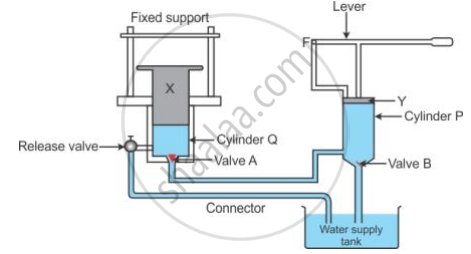
- Name the parts labelled by the letters X and Y.
- Describe what happens to valves A and B and to the quantity of water in the two cylinders when the lever arm is moved down.
- Give reasons for what happens to valves A and B in part (ii).
- What happens when the release valve is opened?
- What happens to valve B in cylinder P when the lever arm is moved up?
- Give a reason for your answer in part (v).
- State one use of the above device.
Complete the following sentence :
Pressure at a depth h in a liquid of density p is ......................
The pressure of water on the ground floor is 40,000 Pa and on the first floor is 10,000 Pa. Find the height of the first floor. (Take : density of water = 1000 kg m-3, g = 10 m s-2)
A block of wood is floating on water with its dimensions 50 cm x 50 cm x 50 cm inside water. Calculate the buoyant force acting on the block. Take g = 9.8 N kg-1.
State whether true or false. If false, correct the statement.
The weight of fluid displaced determines the buoyant force on an object.
The upward force that is caused due to the pressure difference in liquid (or fluid) is called ______.
