Advertisements
Advertisements
Question
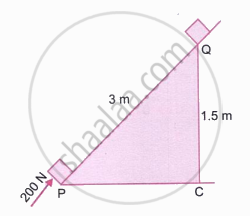
A block of mass 30 kg is pulled up by a rope as shown in Fig. with a constant speed by applying a force of 200 N parallel to the slope. P and Q are the initial and the final positions of the block respectively. Calculate:
- the work done by the force in moving the block from P to Q.
- the potential energy gained by the block.
- account for the difference in work done by the force and the increase in potential energy of the block.
Numerical
Advertisements
Solution
Given: Mass of block, m = 30 kg
Applied force, F = 200 N
Distance along the slope, s = 3 m
Vertical height gained, h = 1.5 m
Taking, g = 10 m s−2
(a) Work done by the force
W = F × s
= 200 × 3
= 600 J
(b) Potential energy gained by the block
PE = mgh
PE = 30 × 10 × 1.5
= 450 J
(c) Difference between work done and increase in potential energy
W − ΔPE
600 − 450 = 150 J
This difference is the work done against friction between the block and the inclined surface. It is mainly converted into heat energy.
shaalaa.com
Is there an error in this question or solution?
