Advertisements
Advertisements
Question
A bicycle wheel, diameter 56 cm, is making 45 revolutions in every 10 seconds. At what speed in kilometre per hour is the bicycle traveling?
Advertisements
Solution
Diameter = 56 cm
∴ Radius, r = 28 cm
∴ Distance travelled in 1 revolution
i.e. circumference = `2pir = 2 xx 22/7 xx 28 = 176` cm
∴ Distance travelled in 45 revolution
= `176 xx 45 = 7920 "cm" = 7920/(100 xx 1000)`km
Time = 10 sec = `10/(60 xx 60)` hr.
Speed = `(7920/(100 xx 1000))/(10/(60 xx 60))`m
= `7920/(100 xx 1000) xx (60 xx 60)/10 = 28512/1000` km/hr
= 28.512 km/hr
APPEARS IN
RELATED QUESTIONS
One side of a rectangle is 12 cm long and its diagonal measures 37 cm. Find the other side and the area of the rectangle.
A rectangular plot measures 125 m by 78 m. It has a gravel path 3 m wide all around on the outside. Find the area of the path and the cost of gravelling it at ₹ 75 per m2.
A footpath of uniform width runs all around the inside of a rectangular field 54 m long and 35 m wide. If the area of the path is 420 m2, find the width of the path.
The hour hand of a clock is 6 cm long. The area swept by it between 11.20 am and 11.55 am is
What is the diameter of a circle whose area is equal to the sum of the areas of two circles of diameters 10 cm and 24 cm?
A rope by which a cow is tethered is increased from 16 m to 23 m. How much additional ground does it have now to graze?
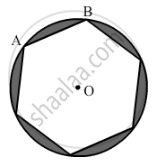
A round table cover has six equal designs as shown in the given figure. If the radius of the cover is 35 cm, then find the total area of the design. [Use `sqrt(3) = 1.732` and π = 3.14.]
Two circles touch externally. The sum of their areas is 130π sq. cm and the distance between their centers is 14 cm. Find the radii of the circles.
Find the radius and area of a circle, whose circumference is :
(i) 132 cm
(ii) 22 m
The length of the minute hand of a clock is 14 cm. The area swept by the minute hand in 5 minutes is ______.
