Advertisements
Advertisements
प्रश्न
A bicycle wheel, diameter 56 cm, is making 45 revolutions in every 10 seconds. At what speed in kilometre per hour is the bicycle traveling?
Advertisements
उत्तर
Diameter = 56 cm
∴ Radius, r = 28 cm
∴ Distance travelled in 1 revolution
i.e. circumference = `2pir = 2 xx 22/7 xx 28 = 176` cm
∴ Distance travelled in 45 revolution
= `176 xx 45 = 7920 "cm" = 7920/(100 xx 1000)`km
Time = 10 sec = `10/(60 xx 60)` hr.
Speed = `(7920/(100 xx 1000))/(10/(60 xx 60))`m
= `7920/(100 xx 1000) xx (60 xx 60)/10 = 28512/1000` km/hr
= 28.512 km/hr
APPEARS IN
संबंधित प्रश्न
From a circular card sheet of radius 14 cm, two circles of radius 3.5 cm and a rectangle of length 3 cm and breadth 1 cm are removed. (as shown in the following figure). Find the area of the remaining sheet. (Take `pi = 22/7`)

The length of the minute hand of a clock is 14 cm. Find the area swept by the minute hand in 5 minutes.
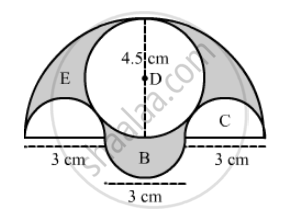
In the following figure, there are three semicircles, A, B and C having diameter 3 cm each, and another semicircle E having a circle D with diameter 4.5 cm are shown. Calculate:
(i) the area of the shaded region
(ii) the cost of painting the shaded region at the rate of 25 paise per cm2 , to the nearest rupee.
Write the area of the sector of a circle whose radius is r and length of the arc is l.
If the circumference and the area of a circle are numerically equal, then diameter of the circle is
If a chord of a circle of radius 28 cm makes an angle of 90 ° at the centre, then the area of the major segment is
A circular disc of radius 6 cm is divided into three sectors with central angles 90°, 120° and 150°. What part of the whole circle is the sector with central angle 150°? Also, calculate the ratio of the areas of the three sectors.
A chord of a circle of radius 10 cm subtends a right angle at the centre. The area of the minor segments (given, π = 3.14) is ______.
A racetrack is in the form of a ring whose inner circumference is 352 m and outer circumference is 396 m. Find the width and the area of the track.
If the radius of a circle is doubled, its area becomes ____________.
