Advertisements
Advertisements
Question
A ball with a velocity of 5 ms−1 impinges at an angle of 60˚ with the vertical on a smooth horizontal plane. If the coefficient of restitution is 0.5, find the velocity and direction after the impact.
Advertisements
Solution
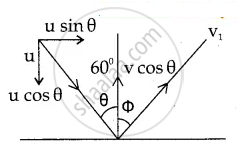
U1 = 5 ms-1
θ = 60°
e = 0.5
v = ?
Initial momentum = final momentum along the original line of m of the con.
∵ The coefficient of restitution is 0.5 (less than 1) the collision is inelastic
Applying component of velocities. The x component of velocity is
u sin θ = v sin Φ → (1)
But the magnitude of the y component is not the same using the coefficient of restitution
`ℓ = (v cos phi)/(u_1 cos theta) = 1` → (2)
squaring and adding (1) & (2)
`u^2 sin^2theta = v^2 sin^2phi`
`e^2 u^2 cos^2theta = v^2 cos^2 phi`
`v^2 = u^2[sin^2theta + e^2cos^2theta]`
v = u`sqrt(sin^-2theta + e^2cos^2theta)`
= 5`sqrt(sin^-2 60 + (0.5)^2 cos^2 60)`
= `5sqrt(3/4 + 0.25 xx 1/4)`
= `5sqrt(0.75 + 0.0625)`
= `5sqrt(0.8125)`
= `5 xx 0.90`
= 4.5 m/s
APPEARS IN
RELATED QUESTIONS
A body is moving unidirectionally under the influence of a source of constant power. Its displacement in time t is proportional to ______.
The blades of a windmill sweep out a circle of area A.
- If the wind flows at a velocity v perpendicular to the circle, what is the mass of the air passing through it in time t?
- What is the kinetic energy of the air?
- Assume that the windmill converts 25% of the wind’s energy into electrical energy, and that A = 30 m2, v = 36 km/h and the density of air is 1.2 kg m–3. What is the electrical power produced?
The expression of power P is
It takes 20 s for a girl A to climb up the stairs while girl B takes 15 s for the same job. Compare the power spent by then.
Define power.
A bullet of mass 20 g strikes a pendulum of mass 5 kg. The centre of mass of the pendulum rises a vertical distance of 10 cm. If the bullet gets embedded into the pendulum, calculate its initial speed.
Water falls from a height of 60 m at the rate of 15 kg/s to operate a turbine. The losses due to frictional force are 10% of the input energy. How much power is generated by the turbine? (g = 10m/s2)
Water falls from a height of 60 m at the rate of 15 kg/s to operate a turbine. The losses due to frictional force are 10% of the input energy. How much power is generated by the turbine? (g = 10 m/s2)
Name the quantity which is measured in Wh.
