Advertisements
Advertisements
Question
68 boxes of a certain commodity require a shelf-length of 13.6 m. How many boxes of the same commodity would occupy a shelf length of 20.4 m?
Advertisements
Solution
| Number of Boxes | 68 | x |
| Shelf-length (in m) | 13.6 | 20.4 |
Let x be the number of boxes that occupy a shelf-length of 20.4 m.
\[\text{ If the length of the shelf increases, the number of boxes will also increase .} \]
\[\text{ Therefore, it is a case of direct variation } . \]
\[\frac{68}{x} = \frac{13 . 6}{20 . 4}\]
\[ \Rightarrow 68 \times 20 . 4 = x \times 13 . 6\]
\[ \Rightarrow x = \frac{68 \times 20 . 4}{13 . 6}\]
\[ = \frac{1387 . 2}{13 . 6}\]
\[ = 102\]
\[\text{ Thus, 102 boxes will occupy a shelf - length of } 20 . 4 m .\]
RELATED QUESTIONS
A machine in a soft drink factory fills 840 bottles in six hours. How many bottles will it fill in five hours?
Rashmi has a road map with a scale of 1 cm representing 18 km. She drives on a road for 72 km. What would be her distance covered in the map?
A 5 m 60 cm high vertical pole casts a shadow 3 m 20 cm long. Find at the same time the length of the shadow cast by another pole 10 m 50 cm high.
In a library 136 copies of a certain book require a shelf-length of 3.4 metre. How many copies of the same book would occupy a shelf-length of 5.1 metres?
Ten men take 4 days to complete the task of tarring a road. How many days would 8 men take?
Expenditure of a family to number of members of the family are in direct proportion
In direct proportion, `a_1/b_1` ______ `a_2/b_2`
The number of workers and the time to complete a job is a case of direct proportion.
Write whether the following statement vary directly, vary inversely with each other, or neither of the two.
Area of land and its cost.
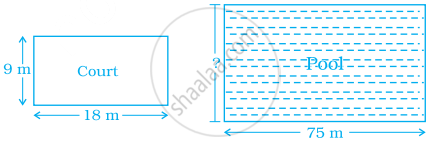
A volleyball court is in a rectangular shape and its dimensions are directly proportional to the dimensions of the swimming pool given below. Find the width of the pool.