Advertisements
Advertisements
Question
(–5)–2 × (–5)–3 = (–5)–6
Options
True
False
Advertisements
Solution
This statement is False.
Explanation:
LHS = (–5)–2 × (–5)–3
Using law of exponents,
am × an = (a)m + n ...[∵ a is non-zero integer]
∴ (–5)–2 × (–5)–3 = (–5)–2 – 3 = (–5)–5
LHS ≠ RHS
APPEARS IN
RELATED QUESTIONS
`(-8/2)^0 = 0`
am × bm = (ab)m
Find the multiplicative inverse of (–7)–2 ÷ (90)–1.
If `5^(3x - 1) ÷ 25 = 125`, find the value of x.
Consider a quantity of a radioactive substance. The fraction of this quantity that remains after t half-lives can be found by using the expression 3–t. What fraction of substance remains after 7 half-lives?
Find a single repeater machine that will do the same work as hook-up.
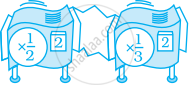
If possible, find a hook-up of prime base number machine that will do the same work as the given stretching machine. Do not use (× 1) machines.

Find a repeater machine that will do the same work as a `(xx 1/8)` machine.
Long back in ancient times, a farmer saved the life of a king’s daughter. The king decided to reward the farmer with whatever he wished. The farmer, who was a chess champion, made an unusal request:
“I would like you to place 1 rupee on the first square of my chessboard, 2 rupees on the second square, 4 on the third square, 8 on the fourth square, and so on, until you have covered all 64 squares. Each square should have twice as many rupees as the previous square.” The king thought this to be too less and asked the farmer to think of some better reward, but the farmer didn’t agree.
How much money has the farmer earned?
[Hint: The following table may help you. What is the first square on which the king will place at least Rs 10 lakh?]
| Position of Square on chess board |
Amount (in Rs) |
| 1st square | 1 |
| 2nd square | 2 |
| 3rd square | 4 |
Mass of Mars is 6.42 × 1029 kg and mass of the Sun is 1.99 × 1030 kg. What is the total mass?
