Advertisements
Advertisements
Question
30 persons can reap a field in 17 days. How many more persons should be engaged to reap the same field in 10 days?
Advertisements
Solution
∵ 30 persons can reap a field in 17 days.
1 person can reap the same field in 30 × 17 i.e. 510 days.
In 10 days, the number of persons required = `510/10` = 51 persons.
APPEARS IN
RELATED QUESTIONS
Suneeta types 1080 words in one hour. What is her GWAM (gross words a minute rate)?
11 men can dig \[6\frac{3}{4}\] metre long trench in one day. How many men should be employed for digging 27 metre long trench of the same type in one day?
If 9 girls can prepare 135 garlands in 3 hours, how many girls are needed to prepare 270 garlands in 1 hour?
Assuming land to be uniformly fertile, the area of land and the yield on it vary ______
100 persons had food provision for 24 days. If 20 persons left the place, the provision will last for ______.
On increasing a, b increases in such a manner that `a/b` remains ______ and positive, then a and b are said to vary directly with each other.
If two quantities x and y vary directly with each other, then ______ of their corresponding values remains constant.
For fixed time period and rate of interest, the simple interest is directly proportional to the principal.
Write whether the following statement vary directly, vary inversely with each other, or neither of the two.
Area of the walls of a room and the cost of white washing the walls.
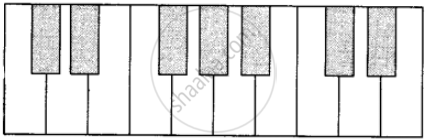
Here is a keyboard of a harmonium: What is the ratio of black keys to all keys on the given keyboard.