Advertisements
Advertisements
Question
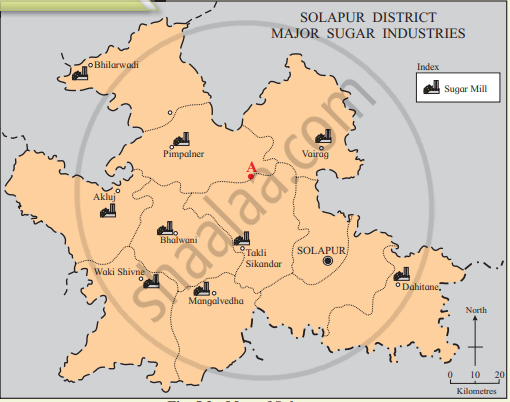
- Look at the map of Solapur district in fig. It shows the location of some sugar industries. Shamrao is a farmer at location A. He has just harvested his sugarcane crop. Study the map and tell where should he send his crop? What factors will Shamrao consider for this?
- Firoz's son has done an advanced course in Bakery Management from the nearby city. He wants his son to start a bakery in their village but his son says it should be in the city, which is around 20 kms from their village. Who is correct? Firoz or his son? Why?
- Shantaram is a young boy from a tribal area in Maharashtra. He wants to start a honey processing unit as he has access to good honeycombs in the forest. The city is around 35 kms away. He has his own land in the village and is also getting land in the city. Where should he establish the honey factory? In the village or in the city? Why?
Advertisements
Solution
1. Shamrao should send his sugarcane to the nearest sugar mill, because sugarcane is bulky and highly perishable after harvesting.
He will consider factors such as:
- Distance from the farm to the sugar mill
- Transport facilities
- Cost of transportation
- Time required to reach the mill
- Availability and capacity of the mill
- Price offered for sugarcane
2. Firoz’s son is more correct. A bakery should preferably be located near the market and consumers because bakery products are perishable and need to be sold quickly. The city will generally provide a larger market, better transport, more customers and better business opportunities.
3. Shantaram should establish the honey processing unit in the village, near the source of raw material. He has easy access to honeycombs in the nearby forest and also owns land in the village.
This will:
- Reduce transportation cost of raw honey
- Ensure regular supply of raw material
- Use his own land
- Provide employment in the village
- Allow the processed honey to be transported later to the city market
Thus, the location of an industry depends on factors such as raw material, market, transport, labour, land and cost.
