Advertisements
Online Mock Tests
Chapters
Advertisements
Solutions for Chapter 6: Attitude and Social Cognition
Below listed, you can find solutions for Chapter 6 of CBSE, Karnataka Board PUC NCERT for साइकोलॉजी [इंग्रजी] इयत्ता १२.
NCERT solutions for साइकोलॉजी [इंग्रजी] इयत्ता १२ 6 Attitude and Social Cognition Intext Questions [Pages 113 - 115]
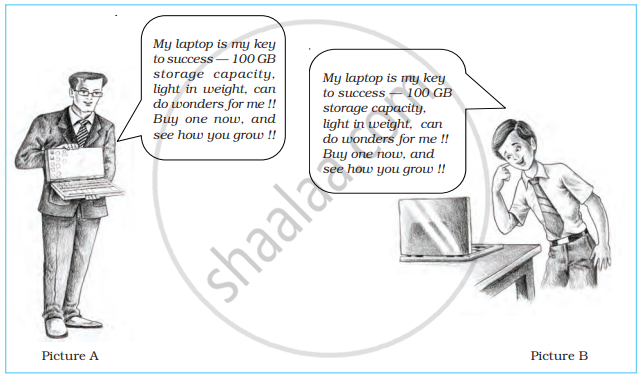
Which Picture will Make You More Eager to Buy a Laptop - Picture A, or Picture B ? Why?
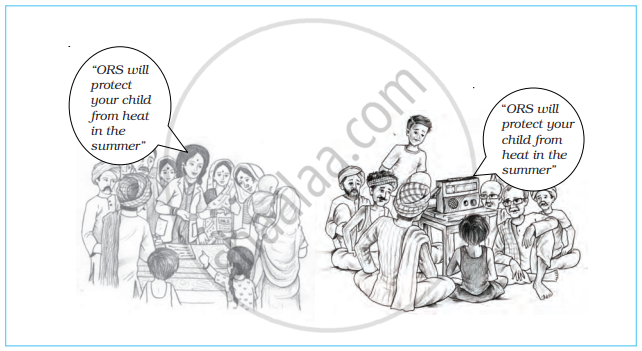
Face-to-face Interaction versus Media Transmission. Which one works better? Why?
Activity
Cut out an advertisement from a newspaper or magazine, that contains something special and catches your attention. Write down the following details about that advertisement, and present it to your class.
- The topic of the advertisement (for example, whether the advertisement is about a consumer product, some food, a company, a health matter, a national theme, etc.).
- Good and bad consequences of the advertisement.
- Whether it contains an emotional appeal or a rational appeal.
- Whether it contains a popular figure: an expert source, or a well-liked person.
NCERT solutions for साइकोलॉजी [इंग्रजी] इयत्ता १२ 6 Attitude and Social Cognition Exercise [Pages 118 - 119]
Define attitude.
Discuss the components of an attitude.
Are attitudes learnt? Explain how?
What are the factors that influence the formation of an attitude?
Is behaviour always a reflection of one’s attitude? Explain with a relevant example.
Differentiate between prejudice and stereotype.
Prejudice can exist without discrimination and vice versa. Comment.
Your friend eats too much junk food, how would you be able to bring about a change in her/his attitude towards food?
Project Ideas
Attitudes Towards and Awareness of Waste Management: A Survey
The problem of household garbage (domestic waste) is common in most Indian cities. The concern for a clean environment is increasing, but we do not know to what extent citizens know how to dispose of the garbage that collects in their household. Along with some of your classmates, conduct a survey in your own colony to find out what people do about household garbage. Each student may visit two houses in their colony, and ask the heads of the household the following questions. Their answers must be written down.
- What do you do with old newspapers, magazines, tins, and bottles?
- What do you do with plastic packets, and other plastic objects (for example, toys, containers etc.)?
- How do you dispose of kitchen waste (e.g., vegetable and fruit peels, used tea leaves or tea-bags, left-over food that cannot be eaten etc.)?
- How do you dispose of other used objects that contain chemical substances (e.g. torch cells, used or damaged CDs, cassettes, insecticide and pesticide containers etc.)?
- Do you put all the garbage collected in your house everyday in the same place, or do you put different kinds of garbage in separate dustbins/waste-baskets?
- What happens to the garbage that is collected from your house and neighbourhood and where is it taken?
- What is the meaning of ‘recycling’?
- What can you do (personally) to make your colony/neighbourhood more clean?
Compare the responses collected by all the students, and see what kind of attitudes and awareness people show about waste management at the household level.
Interpersonal Judgment Exercise
The following exercise will help you to see how well you and your best friend know each other.
For each quality listed below, give ratings for yourself (Column 1) and for your best friend in your class (Column 2). Also ask your friend to do the same kind of rating, for himself/herself (Column 1) and for you (Column 2). Use the following rating scale:
| 1 | 2 | 3 | 4 | 5 |
| Very low on the quality |
Low | Neither low nor high |
High | Very high on the quality |
After you and your friend have completed the ratings, copy Column 2 ratings from your friend’s sheet on your sheet, under Column 3. Compare Column 3 ratings with Column 1 ratings in the case of each quality. Ask your friend to do the same task – that is, copy Column 2 ratings from your sheet on her/his sheet, under Column 3, and compare these ratings with her/his Column 1 ratings. Enter Column 3 minus Column 1 under Column 4.
| Column 1 | Column 2 | Column 3 | Column 4 |
|---|---|---|---|
| You rate yourself | You rate your friend | Rating of you by your friend | Column 3 minus Column 1 |
Friendly
Tense
Sincere
Pleasant
Open to new ideas
Examine the following. Are there any zeros in Column 4? On which quality is the difference greatest? On which quality is the difference smallest (other than zero)? In general, have you given yourself a higher or lower rating than what your friend has given you? Has your friend given herself/himself a higher or lower rating than what you have given your friend? The sign of the difference (plus or minus) should be noted only to see the direction of the difference.
The closer the ratings between Column 1 and Column 3 for both of you, the better you know each other. You can also compare your Column 1 with your friend's Column 1. The more similar these two ratings are, the greater the similarity between you and your friend.
Solutions for 6: Attitude and Social Cognition
NCERT solutions for साइकोलॉजी [इंग्रजी] इयत्ता १२ chapter 6 - Attitude and Social Cognition
Shaalaa.com has the CBSE, Karnataka Board PUC Mathematics साइकोलॉजी [इंग्रजी] इयत्ता १२ CBSE, Karnataka Board PUC solutions in a manner that help students grasp basic concepts better and faster. The detailed, step-by-step solutions will help you understand the concepts better and clarify any confusion. NCERT solutions for Mathematics साइकोलॉजी [इंग्रजी] इयत्ता १२ CBSE, Karnataka Board PUC 6 (Attitude and Social Cognition) include all questions with answers and detailed explanations. This will clear students' doubts about questions and improve their application skills while preparing for board exams.
Further, we at Shaalaa.com provide such solutions so students can prepare for written exams. NCERT textbook solutions can be a core help for self-study and provide excellent self-help guidance for students.
Concepts covered in साइकोलॉजी [इंग्रजी] इयत्ता १२ chapter 6 Attitude and Social Cognition are Prejudice and Discrimination, Nature and Components of Attitudes, Concept of Social Behaviour, Formation of Attitude, Attitude Change, Attitude-Behaviour Relationship, Strategies for Handling Prejudice, Prejudice and Discrimination, Nature and Components of Attitudes, Concept of Social Behaviour, Formation of Attitude, Attitude Change, Attitude-Behaviour Relationship, Strategies for Handling Prejudice.
Using NCERT साइकोलॉजी [इंग्रजी] इयत्ता १२ solutions Attitude and Social Cognition exercise by students is an easy way to prepare for the exams, as they involve solutions arranged chapter-wise and also page-wise. The questions involved in NCERT Solutions are essential questions that can be asked in the final exam. Maximum CBSE, Karnataka Board PUC साइकोलॉजी [इंग्रजी] इयत्ता १२ students prefer NCERT Textbook Solutions to score more in exams.
Get the free view of Chapter 6, Attitude and Social Cognition साइकोलॉजी [इंग्रजी] इयत्ता १२ additional questions for Mathematics साइकोलॉजी [इंग्रजी] इयत्ता १२ CBSE, Karnataka Board PUC, and you can use Shaalaa.com to keep it handy for your exam preparation.
