Advertisements
Online Mock Tests
Chapters
2: Electrostatic Potential and Capacitance
3: Current Electricity
4: Moving Charges and Magnetism
5: Magnetism and Matter
6: Electromagnetic Induction
7: Alternating Current
8: Electromagnetic Waves
9: Ray Optics and Optical Instruments
10: Wave Optics
11: Dual Nature of Radiation and Matter
12: Atoms
13: Nuclei
14: Semiconductor Electronics: Materials, Devices and Simple Circuits
![NCERT solutions for फिज़िक्स पार्ट I अँड II [इंग्रजी] इयत्ता १२ chapter 1 - Electric Charge and Fields - Shaalaa.com](/images/physics-part-i-and-ii-english-class-12_6:a7015f0026ba45cd91348bcbae3323b3.png "NCERT solutions for फिज़िक्स पार्ट I अँड II [इंग्रजी] इयत्ता १२ chapter 1 - Electric Charge and Fields")
Advertisements
Solutions for Chapter 1: Electric Charge and Fields
Below listed, you can find solutions for Chapter 1 of CBSE, Karnataka Board PUC NCERT for फिज़िक्स पार्ट I अँड II [इंग्रजी] इयत्ता १२.
NCERT solutions for फिज़िक्स पार्ट I अँड II [इंग्रजी] इयत्ता १२ 1 Electric Charge and Fields EXERCISES [Pages 42 - 44]
What is the force between two small charged spheres having charges of 2 × 10⁻⁷ C and 3 × 10⁻⁷ C placed 30 cm apart in air?
The electrostatic force on a small sphere of charge 0.4 μC due to another small sphere of charge −0.8 μC in air is 0.2 N.
- What is the distance between the two spheres?
- What is the force on the second sphere due to the first?
Check that the ratio `(ke^2)/(G m_em_p)` is dimensionless. Look up a Table of Physical Constants and determine the value of this ratio. What does the ratio signify?
Explain the meaning of the statement ‘electric charge of a body is quantised’.
Why can one ignore quantisation of electric charge when dealing with macroscopic i.e., large scale charges?
When a glass rod is rubbed with a silk cloth, charges appear on both. A similar phenomenon is observed with many other pairs of bodies. Explain how this observation is consistent with the law of conservation of charge.
Four point charges qA = 2 μC, qB = −5 μC, qC = 2 μC, and qD = −5 μC are located at the corners of a square ABCD of side 10 cm. What is the force on a charge of 1 μC placed at the centre of the square?
- An electrostatic field line is a continuous curve. That is, a field line cannot have sudden breaks. Why not?
- Explain why two field lines never cross each other at any point?
Two point charges qA = 3 μC and qB = −3 μC are located 20 cm apart in vacuum.
- What is the electric field at the midpoint O of the line AB joining the two charges?
- If a negative test charge of magnitude 1.5 × 10⁻⁹ C is placed at this point, what is the force experienced by the test charge?
A system has two charges qA = 2.5 × 10⁻⁷ C and qB = −2.5 × 10⁻⁷ C located at points A: (0, 0, −15 cm) and B: (0, 0, +15 cm), respectively. What are the total charge and electric dipole moment of the system?
An electric dipole with dipole moment 4 × 10⁻⁹ C m is aligned at 30° with the direction of a uniform electric field of magnitude 5 × 10⁴ N C−1. Calculate the magnitude of the torque acting on the dipole.
A polythene piece rubbed with wool is found to have a negative charge of 3 × 10⁻⁷ C.
- Estimate the number of electrons transferred (from which to which?)
- Is there a transfer of mass from wool to polythene?
- Two insulated charged copper spheres A and B have their centers separated by a distance of 50 cm. What is the mutual force of electrostatic repulsion if the charge on each is 6.5 × 10⁻⁷ C? The radii of A and B are negligible compared to the distance of separation.
- What is the force of repulsion if each sphere is charged double the above amount, and the distance between them is halved?
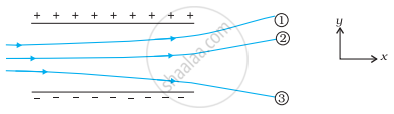
The figure shows tracks of three charged particles in a uniform electrostatic field. Give the signs of the three charges. Which particle has the highest charge to mass ratio?
Consider a uniform electric field E = 3 × 10³ `hat i` N/C.
- What is the flux of this field through a square of 10 cm on a side whose plane is parallel to the yz plane?
- What is the flux through the same square if the normal to its plane makes a 60° angle with the x-axis?
What is the net flux of the uniform electric field of previous question through a cube of side 20 cm oriented so that its faces are parallel to the coordinate planes?
Careful measurement of the electric field at the surface of a black box indicates that the net outward flux through the surface of the box is 8.0 × 10³ N m2/C.
- What is the net charge inside the box?
- If the net outward flux through the surface of the box were zero, could you conclude that there were no charges inside the box? Why or Why not?
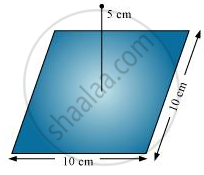
A point charge +10 μC is a distance 5 cm directly above the centre of a square of side 10 cm, as shown in the Figure. What is the magnitude of the electric flux through the square? (Hint: Think of the square as one face of a cube with edge 10 cm.)
A point charge of 2.0 μC is at the centre of a cubic Gaussian surface 9.0 cm on edge. What is the net electric flux through the surface?
A point charge causes an electric flux of −1.0 × 10³ Nm2/C to pass through a spherical Gaussian surface of 10.0 cm radius centred on the charge.
- If the radius of the Gaussian surface were doubled, how much flux would pass through the surface?
- What is the value of the point charge?
A conducting sphere of radius 10 cm has an unknown charge. If the electric field 20 cm from the centre of the sphere is 1.5 × 10³ N/C and points radially inward, what is the net charge on the sphere?
A uniformly charged conducting sphere of 2.4 m diameter has a surface charge density of 80.0 μC/m2.
- Find the charge on the sphere.
- What is the total electric flux leaving the surface of the sphere?
An infinite line charge produces a field of 9 × 10⁴ N/C at a distance of 2 cm. Calculate the linear charge density.
Two large, thin metal plates are parallel and close to each other. On their inner faces, the plates have surface charge densities of opposite signs and of magnitude 17.0 × 10⁻²² C/m2. What is E:
- in the outer region of the first plate,
- in the outer region of the second plate, and
- between the plates?
Solutions for 1: Electric Charge and Fields
NCERT solutions for फिज़िक्स पार्ट I अँड II [इंग्रजी] इयत्ता १२ chapter 1 - Electric Charge and Fields
Shaalaa.com has the CBSE, Karnataka Board PUC Mathematics फिज़िक्स पार्ट I अँड II [इंग्रजी] इयत्ता १२ CBSE, Karnataka Board PUC solutions in a manner that help students grasp basic concepts better and faster. The detailed, step-by-step solutions will help you understand the concepts better and clarify any confusion. NCERT solutions for Mathematics फिज़िक्स पार्ट I अँड II [इंग्रजी] इयत्ता १२ CBSE, Karnataka Board PUC 1 (Electric Charge and Fields) include all questions with answers and detailed explanations. This will clear students' doubts about questions and improve their application skills while preparing for board exams.
Further, we at Shaalaa.com provide such solutions so students can prepare for written exams. NCERT textbook solutions can be a core help for self-study and provide excellent self-help guidance for students.
Concepts covered in फिज़िक्स पार्ट I अँड II [इंग्रजी] इयत्ता १२ chapter 1 Electric Charge and Fields are Electric Field, Electric Charge, Conductors and Insulators, Basic Properties of Electric Charge, Coulomb’s Law, Forces between Multiple Charges, Electric Field Lines, Application of Gauss' Law, Electric Field Due to a System of Charges, Physical Significance of Electric Field, Electric Flux, Electric Dipole, Dipole in a Uniform External Field, Continuous Charge Distribution, Gauss’s Law.
Using NCERT फिज़िक्स पार्ट I अँड II [इंग्रजी] इयत्ता १२ solutions Electric Charge and Fields exercise by students is an easy way to prepare for the exams, as they involve solutions arranged chapter-wise and also page-wise. The questions involved in NCERT Solutions are essential questions that can be asked in the final exam. Maximum CBSE, Karnataka Board PUC फिज़िक्स पार्ट I अँड II [इंग्रजी] इयत्ता १२ students prefer NCERT Textbook Solutions to score more in exams.
Get the free view of Chapter 1, Electric Charge and Fields फिज़िक्स पार्ट I अँड II [इंग्रजी] इयत्ता १२ additional questions for Mathematics फिज़िक्स पार्ट I अँड II [इंग्रजी] इयत्ता १२ CBSE, Karnataka Board PUC, and you can use Shaalaa.com to keep it handy for your exam preparation.
