Advertisements
Online Mock Tests
Chapters
2: Electrostatic Potential and Capacitance
▶ 3: Current Electricity
4: Moving Charges and Magnetism
5: Magnetism and Matter
6: Electromagnetic Induction
7: Alternating Current
8: Electromagnetic Waves
9: Ray Optics and Optical Instruments
10: Wave Optics
11: Dual Nature of Radiation and Matter
12: Atoms
13: Nuclei
14: Semiconductor Electronics: Materials, Devices and Simple Circuits
![NCERT solutions for फिज़िक्स पार्ट I अँड II [इंग्रजी] इयत्ता १२ chapter 3 - Current Electricity - Shaalaa.com](/images/physics-part-i-and-ii-english-class-12_6:a7015f0026ba45cd91348bcbae3323b3.png "NCERT solutions for फिज़िक्स पार्ट I अँड II [इंग्रजी] इयत्ता १२ chapter 3 - Current Electricity")
Advertisements
Solutions for Chapter 3: Current Electricity
Below listed, you can find solutions for Chapter 3 of CBSE, Karnataka Board PUC NCERT for फिज़िक्स पार्ट I अँड II [इंग्रजी] इयत्ता १२.
NCERT solutions for फिज़िक्स पार्ट I अँड II [इंग्रजी] इयत्ता १२ 3 Current Electricity EXERCISES [Pages 105 - 106]
The storage battery of a car has an emf of 12 V. If the internal resistance of the battery is 0.4 Ω, what is the maximum current that can be drawn from the battery?
A battery of emf 10 V and internal resistance 3 Ω is connected to a resistor. If the current in the circuit is 0.5 A, what is the resistance of the resistor? What is the terminal voltage of the battery when the circuit is closed?
At room temperature (27.0°C) the resistance of a heating element is 100 Ω. What is the temperature of the element if the resistance is found to be 117 Ω, given that the temperature coefficient of the material of the resistor is 1.70 × 10⁻⁴ °C−1.
A negligibly small current is passed through a wire of length 15 m and uniform cross-section 6.0 × 10⁻⁷ m2, and its resistance is measured to be 5.0 Ω. What is the resistivity of the material at the temperature of the experiment?
A silver wire has a resistance of 2.1 Ω at 27.5°C, and a resistance of 2.7 Ω at 100°C. Determine the temperature coefficient of resistivity of silver.
A heating element using nichrome connected to a 230 V supply draws an initial current of 3.2 A which settles after a few seconds to a steady value of 2.8 A. What is the steady temperature of the heating element if the room temperature is 27.0°C? The temperature coefficient of resistance of nichrome averaged over the temperature range involved is 1.70 × 10⁻⁴ °C−1.
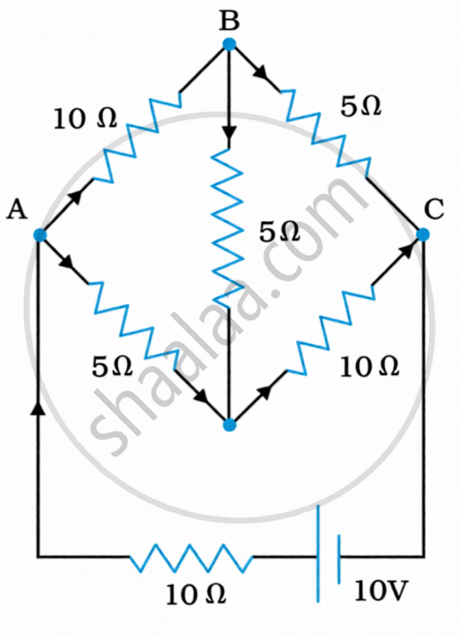
Determine the current in each branch of the network shown in figure.
A storage battery of emf 8.0 V and internal resistance 0.5 Ω is being charged by a 120 V dc supply using a series resistor of 15.5 Ω. What is the terminal voltage of the battery during charging? What is the purpose of having a series resistor in the charging circuit?
The number density of free electrons in a copper conductor is 8.5 × 1028 m−3. How long does an electron take to drift from one end of a wire 3.0 m long to its other end? The area of cross-section of the wire is 2.0 × 10⁻⁶ m2 and it is carrying a current of 3.0 A.
Solutions for 3: Current Electricity
NCERT solutions for फिज़िक्स पार्ट I अँड II [इंग्रजी] इयत्ता १२ chapter 3 - Current Electricity
Shaalaa.com has the CBSE, Karnataka Board PUC Mathematics फिज़िक्स पार्ट I अँड II [इंग्रजी] इयत्ता १२ CBSE, Karnataka Board PUC solutions in a manner that help students grasp basic concepts better and faster. The detailed, step-by-step solutions will help you understand the concepts better and clarify any confusion. NCERT solutions for Mathematics फिज़िक्स पार्ट I अँड II [इंग्रजी] इयत्ता १२ CBSE, Karnataka Board PUC 3 (Current Electricity) include all questions with answers and detailed explanations. This will clear students' doubts about questions and improve their application skills while preparing for board exams.
Further, we at Shaalaa.com provide such solutions so students can prepare for written exams. NCERT textbook solutions can be a core help for self-study and provide excellent self-help guidance for students.
Concepts covered in फिज़िक्स पार्ट I अँड II [इंग्रजी] इयत्ता १२ chapter 3 Current Electricity are Limitations of Ohm’s Law, Resistivity of Various Materials, Temperature Dependence of Resistivity, Cells, EMF, and Internal Resistance, Kirchhoff’s Laws, Wheatstone Bridge, Ohm's Law, Drift of Electrons and the Origin of Resistivity, Electric Current, Electric Currents in Conductors, Mobility of Electrons, Electrical Energy and Power in Conductors, Cells in Series and in Parallel, Limitations of Ohm’s Law, Resistivity of Various Materials, Temperature Dependence of Resistivity, Cells, EMF, and Internal Resistance, Kirchhoff’s Laws, Wheatstone Bridge, Ohm's Law, Drift of Electrons and the Origin of Resistivity, Electric Current, Electric Currents in Conductors, Mobility of Electrons, Electrical Energy and Power in Conductors, Cells in Series and in Parallel.
Using NCERT फिज़िक्स पार्ट I अँड II [इंग्रजी] इयत्ता १२ solutions Current Electricity exercise by students is an easy way to prepare for the exams, as they involve solutions arranged chapter-wise and also page-wise. The questions involved in NCERT Solutions are essential questions that can be asked in the final exam. Maximum CBSE, Karnataka Board PUC फिज़िक्स पार्ट I अँड II [इंग्रजी] इयत्ता १२ students prefer NCERT Textbook Solutions to score more in exams.
Get the free view of Chapter 3, Current Electricity फिज़िक्स पार्ट I अँड II [इंग्रजी] इयत्ता १२ additional questions for Mathematics फिज़िक्स पार्ट I अँड II [इंग्रजी] इयत्ता १२ CBSE, Karnataka Board PUC, and you can use Shaalaa.com to keep it handy for your exam preparation.
