Advertisements
Chapters
1: Budgeting and Savings
2: Space Organisation in the Kitchen
3: Home Furnishings
UNIT 2: GROWTH AND DEVELOPMENT DURING MIDDLE CHILDHOOD
▶ 4: Milestones of Development
5: Role of Family, Peer Group and School
6: Learning Disabilities in Children
UNIT 3: MEAL PLANNING
7: Balanced Diet
8: Meal Planning for the Family
9: Storage and Preservation of Food
UNIT 4: SELECTION AND CARE OF TEXTILE AND CLOTHING
10: Selection of Fabrics
11: Selection of Readymade Garments
12: Laundering
13: Laundry Material
UNIT 5: COMMUNICATION AND EXTENSION
14: Social and Economic Issues in India
15: Role of Government Towards A Developed India
16: Communication Aids
![Dr. Alka Agarwal, Urvi Raval solutions for होम सायन्स [इंग्रजी] इयत्ता १० आईसीएसई chapter 4 - Milestones of Development - Shaalaa.com](/images/home-science-english-class-10-icse_6:47f2a0e2bbf14b0390712d5a5fb6e473.jpg "Dr. Alka Agarwal, Urvi Raval solutions for होम सायन्स [इंग्रजी] इयत्ता १० आईसीएसई chapter 4 - Milestones of Development")
Advertisements
Solutions for Chapter 4: Milestones of Development
Below listed, you can find solutions for Chapter 4 of CISCE Dr. Alka Agarwal for होम सायन्स [इंग्रजी] इयत्ता १० आईसीएसई.
Dr. Alka Agarwal, Urvi Raval solutions for होम सायन्स [इंग्रजी] इयत्ता १० आईसीएसई 4 Milestones of Development EXERCISES [Pages 60 - 64]
OBJECTIVE QUESTIONS Choose the correct option
Growth ______.
is external in nature
can be directly measured
is quantitative change
All of these
A significant stage or an event in the development of an individual ______.
Heredity
Growth
Puberty
Milestone
Which of the following is important for a child’s emotions?
Emotions add pleasure to everyday experiences.
Emotions serve as a form of communication.
Emotions are sources of social and self-evaluation.
All of the above
Development is related to _____.
Progressive changes
Unfolding traits
Quantitative changes
Changes due to heredity
The areas of cognitive development of a 13-year child focus on ______.
ideas of cause and effect
logical thinking
symbolical words
object permanence
Fill in the blanks
______ is/are the factor(s) affecting the physical development of a child in middle childhood.
Height and weight
Healthy environment
Nutritious food
All of these
The age between ______ years is termed as late childhood.
7 to 11 years
14 to 19 years
3 to 4 years
12 to 16 years
Piaget’s theory occurs in the ______ stage.
Formal operational stage
Sensorimotor stage
Pre-operational stage
Concrete operational stage
All of the above
Select the odd pair.
Formal operational - 12 years to adult
Sensorimotor - 0 to 2 years
Concrete operational - 12 to 18 months
Preoperational - 2 to 7 years
Select the odd pair.
Physical development - Body proportions
Ectomorphs - Thin build
Middle childhood - Arms and legs much longer
Teeth - Emotional development
Select the odd pair.
Cognitive development - learning
Social development - behave in a manner acceptable at home
Emotional development - expressing themselves
Language development - communication skills
State True or False:
Children usually develop their second set of molars around the age of 2 to 3 years.
State True or False:
In physical development, the big muscles develop first, and then the fine muscles.
State True or False:
Children becoming fearful of strangers is a characteristic of emotional development.
Identify the correct option.
Piaget’s theory explains the development of ______.
Cognition
Physical
Motor
Social
Early childhood is called ______.
Pre-gang age
Gang age
Post-gang age
Peer gang age
The ability to produce recognizable speech and pronounce the sounds and words is ______.
Development of Grammar
Semantic Development
Phonological Development
Leaming from age mates
Identify the correct statement:
Assertion (A): The term development is not limited to growing physically larger.
Reason (R): Growth refers to an increase in the size and weight of a child.
A is true but R is false.
A is false but R is true.
Both A and R are true and R is the correct explanation of A.
Both A and R are true and R is not the correct explanation of A.
Assertion (A): During middle childhood years an individual gets well-developed eye and hand coordination.
Reason (R): The children at this age make decisions on their own.
A is true but R is false.
A is false but R is true.
Both A and R are true and R is the correct explanation of A.
Both A and R are true and R is not the correct explanation of A.
Assertion (A): Phonological development produces recognisable speech sounds.
Reason (R): Gestures help in learning new words.
A is true but R is false.
A is false but R is true.
Both A and R are true and R is the correct explanation of A.
Both A and R are true and R is not the correct explanation of A.
Choose the correct pair:
Categorization - 3.5 to 7 years
Structure of sentence - 18 months
Operational changes - asking questions
Complex structured sentence – 2 years
Choose the correct pair:
Emotion - helps in muscle balance
Language - concrete operations
Learning - stranger fear
Cognitive development - Piaget’s theory
Select the incorrect pair:
Formal operations - 12 to adults
Preoperational stage - 40 to 50 years
Concrete operational stage - 7 to 12 years
Sensorimotor stage - 0 to 2 years
Select the incorrect pair:
Quantitative change - growth
Can be measured - growth
Depends on environment - growth
refers to learning - development
Choose the correct statement:
Statement I: Language development can be positively influenced by economic stability, as families with stable incomes have more resources to invest in their children.
Statement II: Economic hardship has no impact on a child’s language development since language skills are only influenced by genetics.
Statement I is true and Statement II is false.
Statement I is false and Statement II is true.
Both Statements I and II are true.
Both Statements I and II are false.
Statement I: During the gang age, children prefer to spend most of their time alone and show little interest in group activities.
Statement II: The gang age is typically characterized by children avoiding social roles and responsibilities within their peer groups.
Statement I is true and Statement II is false.
Statement I is false and Statement II is true.
Both Statements I and II are true.
Both Statements I and II are false.
Choose the correct pair:
| A. | Infancy | 1. | Rapid physical growth and motor skills |
| B. | Childhood | 2. | Development of social and language skills |
| C. | Adolescence | 3. | Identity formation and independence |
| D. | Adulthood | 4. | Career establishment and relationships |
A - 1, B - 2, C - 3, D - 4
A - 2, B - 1, C - 4, D - 3
A - 3, B - 4, C - 2, D - 1
A - 4, B - 3, C - 1, D - 2
Choose the correct pair:
| A. | Conservation understanding | 1. | Concrete Operational |
| B. | Pretend play | 2. | Preoperational |
| C. | Hypothetical-deductive reasoning | 3. | Formal Operational |
| D. | Reflex actions | 4. | Sensorimotor |
A - 1, B - 2, C - 3, D - 4
A - 2, B - 1, C - 4, D - 3
A - 3, B - 4, C - 2, D - 1
A - 4, B - 3, C - 1, D - 2
What skills are being used by the child while solving puzzles?
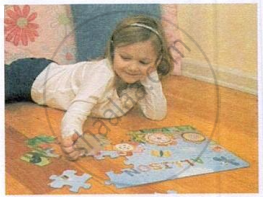
Motor skills
Social interactive skills
Cognitive skills
Language development skill
SHORT QUESTIONS
List any two characteristics of the children’s peer group during middle childhood.
List any two social behavioural patterns developed in middle childhood.
Give two differences between growth and development.
State five factors affecting the physical development of the child.
Define cognitive development in a child.
List two body types commonly seen during childhood.
Mention two developmental tasks observed in children between 6-12 years.
Define ‘social development’.
Define the term ‘language development’.
What is the emotional development of child?
How does language development take place during childhood?
What do you understand by development tasks?
LONG QUESTIONS
State the factors affecting the emotional development in child.
What is gang-age?
Discuss the relationship between the socio-economic status of the family and the development of language in a child.
Discuss the areas in which physical development takes place during late childhood.
State any five changes that occur in the social behavior of an 8-year-old child.
During the late childhood, children are in their formative years. Freud called it the ‘latency period’.
In this context, answer the following question:
What is the other name for late childhood stage?
During the late childhood, children are in their formative years. Freud called it the ‘latency period’.
In this context, answer the following question:
Mention two characteristics of gang age.
During the late childhood, children are in their formative years. Freud called it the ‘latency period’.
In this context, answer the following question:
In which stage of cognitive development do they fall?
Define ‘social development’.
Social development involves learning the values, knowledge and skills that enables children to relate to others effectively and to contribute in positive ways to family, school and the community.
In this context, answer the following question:
List any two characteristics of social development in early years.
Explain any five characteristics of gang age among middle childhood.
Solutions for 4: Milestones of Development
Dr. Alka Agarwal solutions for होम सायन्स [इंग्रजी] इयत्ता १० आईसीएसई chapter 4 - Milestones of Development
Shaalaa.com has the CISCE Mathematics होम सायन्स [इंग्रजी] इयत्ता १० आईसीएसई CISCE solutions in a manner that help students grasp basic concepts better and faster. The detailed, step-by-step solutions will help you understand the concepts better and clarify any confusion. Dr. Alka Agarwal solutions for Mathematics होम सायन्स [इंग्रजी] इयत्ता १० आईसीएसई CISCE 4 (Milestones of Development) include all questions with answers and detailed explanations. This will clear students' doubts about questions and improve their application skills while preparing for board exams.
Further, we at Shaalaa.com provide such solutions so students can prepare for written exams. Dr. Alka Agarwal textbook solutions can be a core help for self-study and provide excellent self-help guidance for students.
Concepts covered in होम सायन्स [इंग्रजी] इयत्ता १० आईसीएसई chapter 4 Milestones of Development are Milestones of Development, Growth and Development of Life, Concept of Gang Age, Stages of Development, Physical Development (Middle Childhood - 6 to 12 Years), Social Development (Middle Childhood 6-12 Years), Emotional Development (Middle Childhood 6-12 Years), Cognitive Development (Middle Childhood 6 To12 Years), Language Development (Middle Childhood 6to12 Years), Developmental Tasks.
Using Dr. Alka Agarwal होम सायन्स [इंग्रजी] इयत्ता १० आईसीएसई solutions Milestones of Development exercise by students is an easy way to prepare for the exams, as they involve solutions arranged chapter-wise and also page-wise. The questions involved in Dr. Alka Agarwal Solutions are essential questions that can be asked in the final exam. Maximum CISCE होम सायन्स [इंग्रजी] इयत्ता १० आईसीएसई students prefer Dr. Alka Agarwal Textbook Solutions to score more in exams.
Get the free view of Chapter 4, Milestones of Development होम सायन्स [इंग्रजी] इयत्ता १० आईसीएसई additional questions for Mathematics होम सायन्स [इंग्रजी] इयत्ता १० आईसीएसई CISCE, and you can use Shaalaa.com to keep it handy for your exam preparation.
