C. B. Gupta solutions for बिझनेस स्टडीज [इंग्रजी] इयत्ता १२ आयसीएसई chapter 11 - Staff Promotion and Transfer [Latest edition]
Chapters
2: Job Analysis and Manpower Planning
3: Staff Recruitment
4: Staff Selection
5: Staff Training
6: Staff Morale
7: Staff Motivation
8: Staff Remuneration
9: Staff Leadership
10: Staff Appraisal
▶ 11: Staff Promotion and Transfer
12: Staff Separation
13: Emerging Trends in Human Resources
14: Business Communication
15: Business Correspondence
16: Reports and Report Writing
17: Various Business Entities
18: Sources of Business Finance
19: Globalisation
20: E-Business
21: Outsourcing
22: Business Regulators and Intermediaries
Advertisements
Advertisements
Solutions for Chapter 11: Staff Promotion and Transfer
Below listed, you can find solutions for Chapter 11 of CISCE C. B. Gupta for बिझनेस स्टडीज [इंग्रजी] इयत्ता १२ आयसीएसई.
Advertisements
C. B. Gupta solutions for बिझनेस स्टडीज [इंग्रजी] इयत्ता १२ आयसीएसई 11 Staff Promotion and Transfer EXERCISES [Pages 193 - 199]
MCQ's (Select the best Alternative)
Promotion may be known as ______.
Advancement of an employee to a higher job.
Upgrade of one's status carrying higher salary.
Both (a) and (b) above
Neither (a) or (b) above
Open promotion of an employee mean ______.
all the employees are considered as the candidates for promotion.
all the employees are not considered as the candidate.
vacancies are not announced to employees.
None of the above.
Which of the following is a limitations of promotion?
Persons pronounced from inside way not possess required qualifications.
More talented persons from outside may not be employed.
Mobility of workers is stopped as a person will stick to the organisation which he joins.
All of the above.
Upgrading of an employee means:
- movement from one lower pay scale to higher scale.
- without change in the status of an employee.
- increase in salary of an employee.
Only (i) and (iii)
Only (iii) and (ii)
Only (iii)
(i), (ii) and (iii)
The need for transfer may arise due to ______.
make the employee more versatile
adjust the workforce
punish the employee
All or any one may be the reason
A promotion policy which considers only a select few employees as potential candidates for promotion is called a/an ______ Policy.
Open
Closed
Confidential
Secured
Assertion (A): Promotion is a move within the organisation to a higher position that has greater responsibilities and requires more skills that are advanced.
Reason (R): Promotion may not involve a raise in status but a hike in salary is a must.
Both (A) and (R) are true and (R) is the correct explanation of (A).
Both (A) and (R) are true, but (R) is not the correct explanation of (A).
(A) is true, but (R) is false.
(A) is false, but (R) is true.
What does the following image depicts?
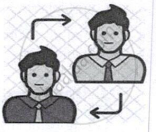
Promotion
Upgrading
Transfer
Dry Promotion
Which one of the following types of transfers is done to stabilise employment when a particular department/branch of an organisation is understaffed?
Production Transfer
Remedial Transfer
Versatility Transfer
Replacement Transfer
Given below are two statements:
Statements I: The promotion policy should be reviewed and updated only once in a year.
Statement II: A sound performance appraisal system must be developed to assess merit.
In the light of the above statements, choose the most appropriate answer from the options given below:
Both Statement I and II are correct
Both Statement I and II are incorrect
Statement I is correct but Statement II is incorrect
Statement I is incorrect but Statement II is correct
Which of the following statement/s are correct?
- When promotions are done based on seniority, junior employees have no incentive to improve their performance.
- Seniority deserves to be recognized and rewarded.
- A sound promotion policy should be based on the combination of both seniority and merit.
- The lines of promotion should be clearly defined for each job.
(i), (ii), (iii)
(ii), (iii), (iv)
(i), (iii), (iv)
(i), (ii), (iii), (iv)
What does the following image depict?

Production transfer
Versatility Transfer
Shift Transfers
Remedial Transfer
Transfer : Horizontal movement : : Promotion : ______.
Downward
Vertical
Diagonal
Flat
Company Z adopted a targeted promotion policy, which involved selective sharing of promotion details with designated decision-makers thereby limiting participation to a chosen few.
What method of promotion policy has been adopted by the company?
Open policy
Closed policy
Upgradation
Dry promotion
Fill in the blanks with suitable words given in brackets.
Increase in wage or salary without increase in status is called ______.
upgrading
degrading
demotion
______ of employee is vertical as it involves moving an employee from lower job to higher job.
transfer
promotion
upgradation
Shifting of an employee to a higher level job with or without any increase or decrease of salary is ______.
dry promotion
demotion
promotion
______ promotions are the best way to promoting because it is the reward for ability.
seniority
transfer
Merit-based
The need and purposes of transfer may arise due ______.
to meet organisation needs
to peers feedback
The solution to the problem of Seniority promotion and Merit promotion is ______.
Remedial transfer
Seniority-cum-merit promotion
Transfer
If an employee is by mistake given a job for which he is not fit, he may be transferred to the right job. Such transfer is the example of ______ transfer.
Production
Versatility
Remedial
Length of service put in by an employee indicates ______.
Experiment
Experience
Promotion
The morale of the seniors is likely to be ______ when promotions are done based on seniority.
High
Low
Stagnant
The qualifications and experience required to earn promotion should be ______.
spontaneous
prescribed
anytime
A movement to a higher pay scale without any change in the status of the employee is known as ______.
______ transfer refers to the practice of shifting employees across different roles, functions, or departments in an organisation to widen their skills.
True or False.
Transfers that are made to develop all round proficiency among employees is known as Production Transfer.
True or False.
The promotion policy should be reviewed and updated at regular intervals.
True or False.
There is no increase in salary in case of dry promotion.
True or False.
Upgrading does not affect our status or responsibility.
True or False.
Transfers are vertical movement.
True or False.
Seniority deserves to be recognized and rewarded.
True or False.
Staff transfer refers to a vertical movement of an employee to enjoy the leave, it results in deduction of pay during the period of leave.
What do you mean by transfer of an employee?
What do you mean by promotion of an employee?
Write two types of transfer of an employee.
Distinguish between open promotion and closed promotion on any one reason.
Distinguish between dry promotion and upgrading on any one basis.
Who initiates transfer?
“When promotions are based on seniority, it leads to inefficiency.” Justify.
Distinguish between upgradation and promotion.
Why a sound promotion policy is required in an organisation?
Short Answer Type Questions
Define promotion.
Why is promotion policy necessary?
What is ‘Remedial Transfer’?
Define versatility transfer.
Give four arguments in favour of seniority as a sole criterion for promotion.
Name four types of transfer.
Explain two advantages of merit-based promotion.
Explain the significance of versatility transfer.
What is meant by a closed system of promotion?
Briefly explain the concept of open promotion policy.
What is meant by a closed system of promotion?
What is meant by dry promotion?
Explain the significance of remedial transfer.
Differentiate between upgrading and dry promotion.
Answer briefly the following questions:
State any two limitations of promotion of employees in an organisation.
How Seniority based Promotion and Merit Based Promotion are different from each other?
State any four limitations of Promotion.
Briefly explain the bases of promotion that the employer may use to take promotion decisions.
“Sound promotion policy should be based on a combination of both seniority and merit.” Do you agree? Support your answer with reason.
In the private sector, the policy by and large is ‘promote the best man available.’ Which base of promotion does the Private Sector prefer?
Explain the concept of dry promotion in employee advancement.
Explain the concept of upgrading in employee advancement.
Long Answer Type Questions
Define promotion.
Explain the importance of promotion.
Give your arguments for the promotion of staff based on experience.
Give your arguments against promotion of staff based on experience.
Give your arguments for promotion of staff based on merit.
Give your arguments against promotion of staff based on merit.
Promotion of staff should be based on merit rather than experience. Comment.
Internal promotion of staff should be based on age/experience rather than merit or skill. Write for.
Internal promotion of staff should be based on age/experience rather than merit or skill. Write against.
There are different types of transfer because the transfer of staff is based on a variety of considerations. Examine this statement.
Give your arguments in favour of ‘merit’ and ‘seniority’ as a criterion for promotion. Which one will you adopt in your organisation and why?
Seniority should not be the sole criterion for promoting an employee. Justify.
Explain any two types of transfer.
Write a detailed note on seniority-based promotion.
Define promotion.
Write a detailed note on seniority-based promotion.
What is meant by staff transfer in an organisation?
Explain any two types of transfer.
Explain two advantages of merit-based promotion.
State any two disadvantages of merit-based promotion.
What is meant by production transfer?
With regard to promotion, explain the following:
Upgrading
With regard to promotion, explain the following:
Open Promotion
With regard to promotion, explain the following:
Closed promotion
What is staff transfer?
Explain any two types of transfer.
Write a detailed note on seniority-based promotion.
Read the passage given below and answer the questions that follows.
|
Global Enterprises, a multinational organisation, recently initiated a comprehensive staff restructuring strategy aimed at enhancing operational efficiency and employee job satisfaction. The restructuring encompassec different types of transfers for various employees within the organisation.
|
Questions:
- Identify the type of transfer that takes place in each case.
- Explain the reasons (any two) and benefits (any two) behind each type of transfer for the employees involved.
- Differentiate between any two types of transfers given above.
Define promotion.
Explain two advantages of merit-based promotion.
State any two disadvantages of merit-based promotion.
Read the passage given below and answer the questions that follow.
|
Kapoor Garments is a well-known brand which manufactures clothes and sells them through their own showrooms. Recently, there was a major reshuffle in staff placements in Kapoor Garments. Given below are some of the changes in staff placements at Kapoor Garments.
|
- Identify the type of transfer that takes place in cases of Anamika, Abdul, Charu and Diana.
- Identify and briefly explain the concept with regard to the increase in Ramesh's salary.
- Distinguish between Transfer and Promotion.
“A transfer may be temporary or permanent.” Justify.
“Ability criterion ignores the value of experience.” Which base of promotion is this statement pointing out? Are you in favour of the highlighted base of promotion or against of it? Give reason.
Give one difference between promotion and transfer.
Read the passage given below and answer the questions that follow.
|
IBM’s CEO, Arvind Krishna, says, employees’ careers could suffer if they work from home. Krishna told Bloomberg in the Monday interview: “In the short term you probably can be equally productive, but your career does suffer. Moving from there to another role is probably less likely because nobody’s observing them in another context,” he said. “It will be tougher. Not impossible, but probably a lot tougher.” He added that remote workers do not acquire skills, such as dealing with difficult clients. |
Explain the two ways by which an employee can be moved from one position/department to another in an organisation.
State any four limitations of Promotion.
Vasu, a Sales Executive at Sunshine Ltd., has been working with the organisation for fifteen years. He has a good track record. In recognition of his capabilities and long years of service in the organisation, the management promotes him to the post of Sales Manager.
Identify the basis on which Vasu has been promoted. Enumerate any three advantages of this type of promotion.
C. B. Gupta solutions for बिझनेस स्टडीज [इंग्रजी] इयत्ता १२ आयसीएसई 11 Staff Promotion and Transfer QUESTION BANK [Pages 199 - 203]
Give one difference between promotion and transfer.
“Seniority-cum-merit based promotion is very popular.” Comment.
“Promotion and transfer involve internal movement of staff.” Explain.
What is meant by dry promotion?
With regard to promotion, explain the following:
Open Promotion
With regard to promotion, explain the following:
Closed promotion
State any four requirements of a sound promotion policy.
Write two benefits of the transfer of an employee.
Explain the following:
Productions transfer
Define versatility transfer.
Distinguish between open promotion and closed promotion on any one reason.
Differentiate between upgrading and dry promotion.
Evaluate the basis of promotion highlighted in the image given:

| Ms. Jayshree recently completed her post-graduate diploma in human resource management. A few months later, a large steel manufacturing company appointed her as its Human Resource Manager. The company currently employs 800 people and has an expansion plan that may require an additional 200 employees for various roles. After 8 months of excellent performance, the company decided to hire 200 additional employees, and Ms. Jayshree was given the responsibility of managing the recruitment process. Due to the company's satisfaction with her work, she was also promoted alongside this new responsibility. |
- What key event happened to Ms. Jayshree?
- Evaluate the function highlighted in this case.
The following table represents the basis of promotion at FutureTech Ltd.
| Basis of Promotion | No. of Employees Promoted |
|---|---|
| Seniority | 25 |
| Merit | 35 |
| Seniority cum Merit | 20 |
| Dry Promotion | 10 |
| Upgrading | 15 |
Study the above table and answer the following questions:
- Which basis of promotion has been most frequently used by FutureTech Ltd?
- What does the data suggest about the company’s approach to rewarding employees?
- What could be one advantage of following a seniority cum merit based promotion policy?
- Suggest one limitation of seniority based promotion.
Observe the following graph and answer the following questions:
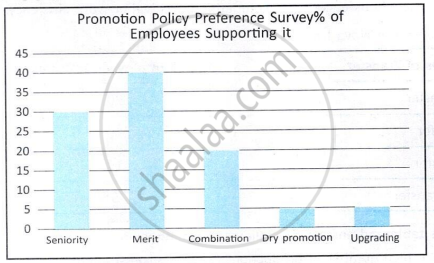
Questions:
- Which promotion basis is least preferred by employees?
- What does the graph reveal about employees’ views on performance based growth?
- Why might employees prefer merit over seniority?
- Suggest a reason why ‘dry promotion’ have low support.
Observe the graph given below and answer the questions:
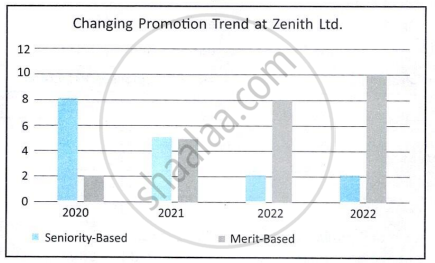
Questions:
- What trend do you notice in the use of seniority and merit-based promotions over time?
- What does this shift suggest about modern management practices?
- Why might seniority-based promotions be declining?
- How can increased merit-based promotions affect employee productivity?
Types of staff transfer at Nova Ltd.
| Types of Transfer | No. of Employees Transferred |
|---|---|
| Production transfer | 20 |
| Remedial transfer | 10 |
| Versatility transfer | 15 |
| Replacement transfer | 5 |
Study the above table and answer the following questions:
- What does the high number of production transfers suggest about Nova Ltd.’s operations?
- Why might remedial transfers be necessary in an organisation?
- How might frequent replacement transfers affect employee morale?
- What does the balance between production and versatility reveal about Nova Ltd.’s management focus?
- How do versatility transfers contribute to the overall organsational stability?
Observe the following chart and answer the questions given below:
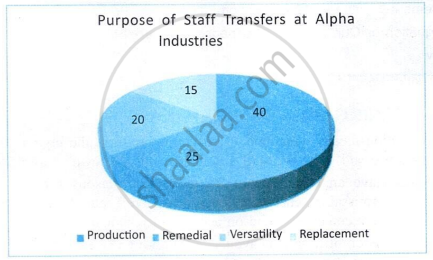
Questions:
- Which purpose of staff transfer is most dominant in the organization?
- What does the prominence of remedial transfers indicate about the company's HR practices?
- Why might versatility transfers be gaining importance in modern industries?
- How can the use of different types of transfers improve organsational efficiency?
Solutions for 11: Staff Promotion and Transfer
C. B. Gupta solutions for बिझनेस स्टडीज [इंग्रजी] इयत्ता १२ आयसीएसई chapter 11 - Staff Promotion and Transfer
Shaalaa.com has the CISCE Mathematics बिझनेस स्टडीज [इंग्रजी] इयत्ता १२ आयसीएसई CISCE solutions in a manner that help students grasp basic concepts better and faster. The detailed, step-by-step solutions will help you understand the concepts better and clarify any confusion. C. B. Gupta solutions for Mathematics बिझनेस स्टडीज [इंग्रजी] इयत्ता १२ आयसीएसई CISCE 11 (Staff Promotion and Transfer) include all questions with answers and detailed explanations. This will clear students' doubts about questions and improve their application skills while preparing for board exams.
Further, we at Shaalaa.com provide such solutions so students can prepare for written exams. C. B. Gupta textbook solutions can be a core help for self-study and provide excellent self-help guidance for students.
Concepts covered in बिझनेस स्टडीज [इंग्रजी] इयत्ता १२ आयसीएसई chapter 11 Staff Promotion and Transfer are Overview of Staff Promotion and Transfer, Meaning and Definition of Promotion, Benefits of Promotion, Limitations of Promotion, Open and Closed Policy of Promotion, Dry Promotion and Upgrading, Demotion, Requirements of a Sound Promotion Policy, Bases of Promotion, Meaning and Definition of Staff Transfer, Need and Purposes of Staff Transfer, Types of Transfer, Is Transfer a Punishment?, Transfer Policy.
Using C. B. Gupta बिझनेस स्टडीज [इंग्रजी] इयत्ता १२ आयसीएसई solutions Staff Promotion and Transfer exercise by students is an easy way to prepare for the exams, as they involve solutions arranged chapter-wise and also page-wise. The questions involved in C. B. Gupta Solutions are essential questions that can be asked in the final exam. Maximum CISCE बिझनेस स्टडीज [इंग्रजी] इयत्ता १२ आयसीएसई students prefer C. B. Gupta Textbook Solutions to score more in exams.
Get the free view of Chapter 11, Staff Promotion and Transfer बिझनेस स्टडीज [इंग्रजी] इयत्ता १२ आयसीएसई additional questions for Mathematics बिझनेस स्टडीज [इंग्रजी] इयत्ता १२ आयसीएसई CISCE, and you can use Shaalaa.com to keep it handy for your exam preparation.
