C. B. Gupta solutions for बिझनेस स्टडीज [इंग्रजी] इयत्ता १२ आयसीएसई chapter 17 - Various Business Entities [Latest edition]
Chapters
2: Job Analysis and Manpower Planning
3: Staff Recruitment
4: Staff Selection
5: Staff Training
6: Staff Morale
7: Staff Motivation
8: Staff Remuneration
9: Staff Leadership
10: Staff Appraisal
11: Staff Promotion and Transfer
12: Staff Separation
13: Emerging Trends in Human Resources
14: Business Communication
15: Business Correspondence
16: Reports and Report Writing
▶ 17: Various Business Entities
18: Sources of Business Finance
19: Globalisation
20: E-Business
21: Outsourcing
22: Business Regulators and Intermediaries
Advertisements
Advertisements
Solutions for Chapter 17: Various Business Entities
Below listed, you can find solutions for Chapter 17 of CISCE C. B. Gupta for बिझनेस स्टडीज [इंग्रजी] इयत्ता १२ आयसीएसई.
Advertisements
C. B. Gupta solutions for बिझनेस स्टडीज [इंग्रजी] इयत्ता १२ आयसीएसई 17 Various Business Entities EXERCISES [Pages 320 - 326]
Objective Type Questions MCQ's (Select the best Alternative)
In Sole Proprietor ______ is maintained.
Full Secrecy
No Secrecy
Secrecy is nominal
None of these
The liability of a Sole Proprietor limited to extent ______.
Capital invested by him
Value of the assets of the business
Value of the business as well his all private assets
None of the above
Which of the following is the limitation of the sole proprietorship?
Unlimited Liability
Limited source of capital
Unbalanced Management
All of these
Sole Proprietor is the best, when ______.
Requires little capital
Require large capital
Capital is not required
None of these
Which of the following is not governed by a specific act?
Sole Proprietorship
Partnership
Company
Co-operative Society
The greater handicap of a sole proprietorship is ______.
Small size
Limited Capital
Unlimited Liability
None of these
Partnership is formed as a result of ______.
License from Government
A central Legislation
An Agreement among Individuals
None of these
A partnership deed is ______.
A written Legal Document
A Verbal Understanding
For sole proprietor and partnership
All of these
A partner in a firm ______.
can transfer his share to an outsider without the consent of other partners
can transfer his share to an outsider with the consent of all to her partners
cannot transfer his share to an outsider
None of the above
Liability of partners in respect of the firm’s debt is ______.
Limited upto the amount of their capital in the business
Unlimited
Limited upto the amount of guarantee given by the Partner
None of these
The minimum number of members to form a private company is ______.
2
3
5
7
A private company is one where ______.
Share transfer is restricted
Shares can be traded on stock exchange
There is no restriction on transfer of shares
None of the above
The liability of shareholder of a public company is limited to the ______.
Paid-up Value of the Shares
Nominal Value of the Shares
Amount called up on Shares
None of these
Himanshi is running a business in sole-proprietorship. Due to loss in business she decided to wind up her business. On the day of winding up the assets are worth Rs 5 lakhs and liabilities are worth Rs 10 lakhs. Himanshi has her personal property of Rs 6 lakhs. How much do you think the creditors will get at the time of winding up of business?
Rs 5 Lakh
Rs 10 Lakh
Rs 7 lakh
Rs 11 Lakh
Sole Proprietorship is a/an ______ type of business.
Formal
Informal
Special
Illegal
Which form of business entity does the following image represent?

Sole Proprietorship
Public Company
Private Limited Company
Partnership Firm
Assertion (A): Partners share profits and losses equally.
Reason (R): Partnership is the relation between persons who have agreed to share the profit of the business carried on by all or anyone of them acting for all.
Both A and R are true and R is the correct explanation of A.
Both A and R are true, but R is not the correct explanation of A.
A is true, but R is false.
A is false, but R is true.
The concept of 'Separate Legal Existence' applies to
- Sole proprietorship
- Partnership
- Joint stock company
- Cooperative society
Choose the correct option:
i and iii
ii and iii
ii and iv
iii and iv
In which business entity, does the following image gets followed:

Sole proprietorship
Partnership
Private Limited Company
Cooperative society
Private Limited Company : 2 Members :: Public Company : ______
5 members
6 members
7 members
10 members
Private limited company : Formal Organisation :: Sole Proprietorship : ______
Informal
Spiritual
Authoritative
Documented
Which Business entity does the following image represent?
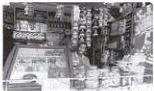
Sole proprietorship
Partnership
Private Limited Company
Cooperative Society
Given below are two statements:
Statement I: Partnership deed helps to avoid disputes in the firm.
Statement II: Sole proprietorship is a one man show.
Both Statement I and II are correct
Both Statement I and II are incorrect
Statement I is correct but Statement II is incorrect
Statement I is incorrect but Statement II is correct
Given below are two statements:
Statement I: Private limited company allows transfer of securities.
Statement II: Public company has no restriction on transfer of securities.
Both Statement I and II are correct
Both Statement I and II are incorrect
Statement I is correct but Statement II is incorrect
Statement I is incorrect but Statement II is correct
Fill in the blanks with suitable words given in brackets
‘Profits do not need to be share’. This statement refers to ______.
Sole Proprietorship
Partnership
Joint Hindu Family
Ram is a Sole Proprietorship who wants to expand his business. He should appoint a ______.
Manager
Partner
Form a Company
The board of directors of a joint-stock company is elected by ______.
General public
Government bodies
Shareholders
Employees
In ______ company there is no restriction on the transfer of shares.
Public Company
Private Company
Chartered Company
In contrast to a private company, a public company can have a ______ number of shareholders and can raise capital through public offerings.
less
more
minimum
A public company is required to have a minimum of ______ and no maximum limit on the number of members.
two
one
seven
A ______ is a written legal agreement that articulates the terms, conditions, and regulations governing a partnership.
memorandum
letter
partnership deed
The maximum number of members that a Private Limited Company can have is ______.
Minimum paid up capital of a Private Limited Company is ______.
₹ 1 Lakh
₹ 5 Lakh
₹ 50,000
As per the Companies Act, a Public Limited Company should have a minimum number of ______ shareholders.
The Partnership Act limits the maximum number of partners in a non-banking partnership firm to ______.
True or False:
In a sole proprietorship firm, the government interference is maximum.
True or False:
There are no legal formalities required to start and close a sole proprietorship firm.
True or False:
In Private Limited Company, the members are allowed to transfer the shares.
True or False:
The relationship of partnership exists out of contract and not out of status.
True or False:
A public company cannot invite the general public to subscribe its shares.
True or False:
Public decides the minimum paid-up share capital in case of private and public companies.
True or False:
A sole proprietor firm has no legal separate existence from its owner.
Very Short Answer Type Questions
Is a sole proprietor formed to publish his/her business accounts?
Which form of business is suitable for a carpentry shop?
Which form of organisation is considered to be the simplest form of organisation?
List two merits of Sole proprietorship.
What is the minimum limit on the members in a Private Company?
What is the maximum limit on the members in a Private Company?
Answer in one sentence only.
What is the minimum number of partners in a partnership firm according to Indian Partnership Act 1932?
Which is the least regulated form of business?
Name the form of business organisation in which the members are jointly and individually liable for payment of the firm’s debts.
What is the nature of liability of partners?
State the law governing the partnership in India.
State one consequence of non-registration of a partnership firm.
Name the form of business organisation in which members are agents and principals of each other.
Name the partner who shares only profits.
In which business organisation, there is separation of ownership and management?
Can a company buy and sell properties, enter contracts, sue and can be sued in its own name? Why?
Name the type of company that doesn’t allow its members to transfer its shares easily.
Answer in one sentence only.
What is the minimum number of partners in a partnership firm according to Indian Partnership Act 1932?
What is the maximum number of partners in a partnership firm?
Suppose you want to open a restaurant in your locality. You will need to gather a lot of things. You may find that it is not possible to arrange the money required to start and run the restaurant by contributing a certain amount of money and the other things required. So all of you join hands together to become the owners and share the profits and losses equally. Which form of business entity will they start?
State the minimum number of directors in Private Company.
State the minimum number of directors in Public Company.
In case of business losses, the proprietor may have to sell the personal property to pay off the liabilities. What is it known as?
"The proprietor enjoys freedom of operation in his concern." Justify.
Name and describe any two contents of the document containing the bye-laws of the company.
Short Answer Type Questions
State the features of proprietorship.
Explain the merits of partnership.
Define Private Limited Company.
What is public company?
Distinguish between Private Limited Company and Public Limited Company.
To form a Public company, there must be minimum 2 persons/promoters.
Define sole proprietorship.
Define partnership.
"Partnership deed helps in avoiding disputes." Do you agree? Support your answer with reason.
Why does partnership originate from the mutual contract among partners?
Explain Principal-Agent Relationship of partners in Partnership firms.
The business assets of a firm are worth ₹ 70,000 but the debts remain unpaid are worth ₹ 1,00,000. What course of action can the creditors take in the following cases.
- The organisation of a sole proprietorship firm.
- The organisation in partnership firm with A and B in which both the partners share profit and losses equally.
Arpita used her savings to start a small business in her town. Her business rapidly gained popularity due to its prompt service and the quality of the goods. Arpita is now considering expanding her business, without changing the ownership status.
- Identify the form of business ownership established by Arpita. (1)
- State any one advantage that Arpita enjoyed by using her savings to start the business. (1)
- Name any one form of business organisation other than the one formed by Arpita. (1)
- Can Arpita invite the public to invest in her business by issuing equity shares? Justify your answer by giving one reason. (1)
Long Answer Type Questions
“Sole proprietorship is a one man show”. Explain.
What is partnership?
Distinguish between Sole Trading Concern and Partnership Firm.
Define Private Limited Company.
How does a private limited company differ from a partnership?
What is public company?
Distinguish between Private Limited Company and Public Limited Company.
State the features of proprietorship.
State any two characteristics of partnership form of business organization.
State the main features of a private company.
What are the defining features of a Public Limited Company?
C. B. Gupta solutions for बिझनेस स्टडीज [इंग्रजी] इयत्ता १२ आयसीएसई 17 Various Business Entities QUESTION BANK [Pages 326 - 331]
Explain Unlimited liability in case of partnership firm.
“Company is an artificial person.” How?
Do you agree that company is not a citizen?
In which form of organisation is a trade agreement made by one owner binding on the others? Give reasons to support your answer.
Explain the limitations of partnership.
“Company is an artificial person with a separate legal entity, perpetual succession and common seal.” Comment.
Define partnership.
lnspite of various limitations the company form of organisation is popular these days? Why it is so?
State any two merits of a Sole trading business.
Which form of business is suitable for the following type of business and why?
Beauty parlour
Which form of business is suitable for the following type of business and why?
Small retail outlet
Which form of business is suitable for the following type of business and why?
Hotels
Which form of business is suitable for the following type of business and why?
Shopping malls
Which form of business is suitable for the following type of business and why?
Medium size trading concern
Distinguish between Sole Trading Concern and Partnership Firm.
How does a private limited company differ from a partnership?
Distinguish between Private Limited Company and Public Limited Company.
According to the Partnership Act, 1932, it is not compulsory for a partnership firm to get itself registered, so why do partners prefer to get the firm registered?
The business assets of a firm are worth Rs. 70,000 but the debts remain unpaid are worth Rs. 1,00,000. What course of action can the creditors take in the following cases,
- The organisation of a sole proprietorship firm.
- The organisation in partnership firm with Anthony and Akbar, two partners sharing profit equally.
A group of eight people decided to make a company and hence approached Foresight Business Consultants, a professional unit for seeking appropriate advice. This company helped them in identifying the different business opportunities and suggested setting up a mobile manufacturing company. Before converting this business opportunity into a real project, Foresight Business Consultants made ascertain arrangements for conducting technical and financial and economical surveys. For this they took the help of specialists like professionals, accountants, lawyers and engineers.
On the basis of the given information about, answer the following questions:
- What are these groups of eight people called?
- List down a few features of the form of business entity pointed out in the case.
The business assets of an organisation amount to ₹ 50,000 but the debts that remain unpaid are ₹ 80,000. What course of action can the creditors take if the organisation is a partnership firm with Anthony and Akbar as partners, who share profits and losses equally. Which of the two partners can the creditors approach for repayment of debt? Explain giving reasons
Abdul is a single owner of a shoe manufacturing business. His business was suffering from continuous losses. To revive his business and to expand, he took a loan of ₹ 20 lakhs from 'Progressive Finance Co.' In spite of starting new range of products and great effort by Abdul, business continued to suffer losses. This resulted in the declining assets and mounting debts. Abdul started defaulting on his repayment schedule. Finance company served him final notice to repay the loan and settle the account. He proposed that the finance company take over the business assets and clear their dues. Finance company took over the assets of the business in part settlement of their dues as the assets were not sufficient to settle the debts and they claimed the remaining amount from Abdul from his personal assets. Abdul refused to do so on the ground that loan was taken for the business and not by him for personal use.
- Name the form of business organization followed by Abdul.
- Is the finance company justified in asking for the remaining amount from Abdul's personal assets?
- "They claimed the remaining amount from Abdul from his personal assets." Which concept does it point out?
Business Ownership in local market (2024)
| Type of Business | Number of Firms | Average Employees | Decision making Speed (1-5)* |
|---|---|---|---|
| Sole Proprietorship | 45 | 3 | 5 |
| Partnership | 25 | 10 | 3 |
| *1=Slow, 5=Very Fast* | |||
Study the above table and answer the questions that follow:
- Which form of business is more common in the local market?
- Why sole proprietorships have fewer employees on an average?
- What does the higher decision making speed indicate?
- What advantage do partnerships have over sole proprietorships in this data?
- What can you conclude about the relationships between ownership type and management flexibility?
The following table represents the ownership and shareholding of different types of companies:
| Ownership and Shareholding | ||
|---|---|---|
| Type of Company | Number of Shareholders | Shares Traded Publicly (Yes/No) |
| Private Limited Company | 25 | No |
| Public Limited Company | 10000+ | Yes |
Observe and Analyze the above table and answer the questions given below:
- Which type of company has more shareholders?
- What does the absence of public share trading indicate about a private company?
- Why might a public company prefer to issue shares to the public?
- Which company form offers more privacy and control to owners?
- What key difference does the data highlight between private and public companies?
The following table shows the comparison between various business entities based on ownership and liability:
| Type of Business | Number of Owners | Liability | Legal Status |
|---|---|---|---|
| Sole Proprietorship | 1 | Unlimited | Not Separate from Owner |
| Partnership | 2-20 | Unlimited | Not Separate from Partners |
| Company | 2+ | Limited | Separate Legal Entity |
Study the above table and answer the following questions:
- What does 'Unlimited liability' mean in this context?
- Which business entity provide legal separation between the owners and the firms?
- What overall trend does the data suggest about the business growth and legal protection?
Observe the following graph and answer the questions that follow:
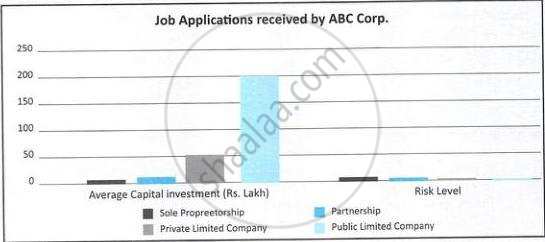
- Which business form requires the highest capital investment?
- Why is the risk lowest for public companies despite high investment?
- What does the high-risk level of sole proprietorship indicate?
- How does capital investment relate to risk in business entities?
- What can investors infer from the graph?
Solutions for 17: Various Business Entities
C. B. Gupta solutions for बिझनेस स्टडीज [इंग्रजी] इयत्ता १२ आयसीएसई chapter 17 - Various Business Entities
Shaalaa.com has the CISCE Mathematics बिझनेस स्टडीज [इंग्रजी] इयत्ता १२ आयसीएसई CISCE solutions in a manner that help students grasp basic concepts better and faster. The detailed, step-by-step solutions will help you understand the concepts better and clarify any confusion. C. B. Gupta solutions for Mathematics बिझनेस स्टडीज [इंग्रजी] इयत्ता १२ आयसीएसई CISCE 17 (Various Business Entities) include all questions with answers and detailed explanations. This will clear students' doubts about questions and improve their application skills while preparing for board exams.
Further, we at Shaalaa.com provide such solutions so students can prepare for written exams. C. B. Gupta textbook solutions can be a core help for self-study and provide excellent self-help guidance for students.
Concepts covered in बिझनेस स्टडीज [इंग्रजी] इयत्ता १२ आयसीएसई chapter 17 Various Business Entities are Overview of Various Business Entities, Sole Proprietorship, Concept of Partnership, Difference Between Partnership and Sole Proprietorship, Private Limited Company, Public Limited Company, Difference Between Private Company and Public Company.
Using C. B. Gupta बिझनेस स्टडीज [इंग्रजी] इयत्ता १२ आयसीएसई solutions Various Business Entities exercise by students is an easy way to prepare for the exams, as they involve solutions arranged chapter-wise and also page-wise. The questions involved in C. B. Gupta Solutions are essential questions that can be asked in the final exam. Maximum CISCE बिझनेस स्टडीज [इंग्रजी] इयत्ता १२ आयसीएसई students prefer C. B. Gupta Textbook Solutions to score more in exams.
Get the free view of Chapter 17, Various Business Entities बिझनेस स्टडीज [इंग्रजी] इयत्ता १२ आयसीएसई additional questions for Mathematics बिझनेस स्टडीज [इंग्रजी] इयत्ता १२ आयसीएसई CISCE, and you can use Shaalaa.com to keep it handy for your exam preparation.
