Advertisements
Advertisements
Give IUPAC name of :
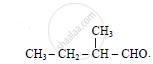
Concept: undefined >> undefined
Write the different oxidation states of iron
Concept: undefined >> undefined
Advertisements
Distinguish between isothermal process and adiabatic process.
Concept: undefined >> undefined
Explain, why lanthanum (Z = 57) forms La3+ ion, while cerium (Z = 58) forms Ce4+ ion?
Concept: undefined >> undefined
Which one of the following oxidation state of Manganese is unstable?
(a) + 2
(b) + 4
(c) + 5
(d) + 7
Concept: undefined >> undefined
What are the sources of Vitamin C and Vitamin K?
Concept: undefined >> undefined
How are the following conversions carried out?
2-methylbutan-1-ol into 2 -methylbutanoic acid.
Concept: undefined >> undefined
Write two uses of formaldehyde
Concept: undefined >> undefined
When KOH solution is added to potassium dichromate solution the colour of solution
changes to yellow, because _______
(A) chromate ion changes to dichromate ion
(B) dichromate ion changes to chromate ion
(C) oxidation number of chromium changes from + 6 to + 4
(D) oxidation number of chromium changes from + 4 to +6
Concept: undefined >> undefined
But-1-ene on reaction with HCl in the presence of sodium peroxide yields _______.
Concept: undefined >> undefined
IUPAC name of is C6H5 − CH2 − C − CH2 − CH2 − CH2 − CH3 is _______
(A) 1-Phenylhexan-2-one
(B) 6-Phenylhexan-5-one
(C) 1-Benzylhexan-5-one
(D) Dodecan-5-one
Concept: undefined >> undefined
How is nitromethane prepared from the following?
alkyl halide
Concept: undefined >> undefined
How is nitromethane prepared from the following?
α-nitroalkene
Concept: undefined >> undefined
How are polymers classified on the basis of polymerisation process?
Concept: undefined >> undefined
Explain effects of lanthanoid contraction.
Concept: undefined >> undefined
What are the consequences of lanthanoid contraction?
Concept: undefined >> undefined
How does calcination differ from roasting?
Concept: undefined >> undefined
Write resonating structures of ozone.
Concept: undefined >> undefined
The decomposition of N2O5(g) at 320K according to the following equation follows first order reaction:
`N_2O_(5(g))->2NO_(2(g))+1/2O_(2(g))`
The initial concentration of N2O5(g) is 1.24 x 10⁻² mol. L-1 and after 60 minutes 0.20x10⁻² molL-1. Calculate the rate constant of the reaction at 320K.
Concept: undefined >> undefined
