Advertisements
Advertisements
प्रश्न
Write two factors that affect the rate of reaction.
List the factors affecting the rate of reaction.
Explain briefly the various factors which affect the rate of a reaction.
On what factors does the rate of a reaction depend?
List any two factors that influence the rate of chemical reaction. Indicate whether the rate constant of the reaction is dependent on or independent of these factors.
Mention any two factors that influence the rate of a chemical reaction.
Mention the factors that affect the rate of a chemical reaction.
Advertisements
उत्तर
- Nature of reactants: The makeup of the reactants affects how quickly a chemical reaction proceeds. For instance, reactions involving polar and ionic chemicals proceed fairly quickly, while those involving covalent compounds proceed considerably more slowly. Because the electrostatic interactions in their molecules are readily disrupted in aqueous solutions, reactions involving polar or ionic compounds proceed relatively quickly. Old bonds are broken and new bonds are formed, or the bonds are rearranged, in a chemical reaction involving covalent reactants. As a result, the rate of a reaction involving the rearrangement of bonds is determined by how easily the particular bonds are made or broken. For example, nitric oxide oxidises to nitrogen peroxide far more quickly than carbon monoxide oxidises to carbon dioxide. The two responses seem to be comparable.
\[\ce{2NO_{(g)} + O2_{(g)} -> 2NO2_{(g)} (fast)}\]
\[\ce{2CO_{(g)} + O2 -> 2CO2_{(g)} (slow)}\]
Because of variations in the energies required for the reactants' bond rearrangement, these two reactions have different speeds. - Concentration of reactants: In general, a reaction's rate rises as the reactant concentration does. Molecular collisions are more likely to occur when a reactant's concentration rises. As a result, the reaction rate rises.
- Temperature: Reaction rates typically rise with temperature. For most homogeneous reactions, increasing the temperature by 10° doubles or triples the rate. Temperature significantly affects reaction rates.
- Surface area: Solid reactants have a higher rate of reaction as their surface area increases. Finely split solid reactants have a higher surface area than huge reactants and react faster. For instance, powdered coal burns faster than lump coal.
Increasing the surface area of a solid reactant improves the contact area between two reactants. This increases the pace of molecular interactions, leading to faster reactions. - Presence of a catalyst: A catalyst is a material that speeds up a reaction while maintaining its amount and chemical makeup.
A catalyst accelerates the rate of a reaction. This is because it offers a less energy-intensive alternate path. Lowering the energy barrier allows more molecules of reactants to cross it. As a result, the rate of reaction rises.
The rate constant depends on the nature of the reactants, temperature, and catalyst, and it is independent of concentration and surface area.
Notes
Students should refer to the answer according to their question.
APPEARS IN
संबंधित प्रश्न
In a first order reaction x → y, 40% of the given sample of compound remains unreacted in 45 minutes. Calculate rate constant of the reaction.
For a chemical reaction R → P, the variation in the concentration (R) vs. time (t) plot is given as:
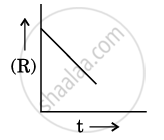
(i) Predict the order of the reaction.
(ii) What is the slope of the curve?
(iii) Write the unit of rate constant for this reaction.
The following data were obtained during the first order thermal decomposition of SO2Cl2 at a constant volume :
SO2Cl2 (g) → SO2 (g) + Cl2 (g)
| Experiment | Time/s–1 | Total pressure/atm |
| 1 | 0 | 0.4 |
| 2 | 100 | 0.7 |
Calculate the rate constant.
(Given : log 4 = 0.6021, log 2 = 0.3010)
The decomposition of N2O5(g) at 320K according to the following equation follows first order reaction:
`N_2O_(5(g))->2NO_(2(g))+1/2O_(2(g))`
The initial concentration of N2O5(g) is 1.24 x 10⁻² mol. L-1 and after 60 minutes 0.20x10⁻² molL-1. Calculate the rate constant of the reaction at 320K.
Consider the reaction A ⇌ B. The concentration of both the reactants and the products varies exponentially with time. Which of the following figures correctly describes the change in concentration of reactants and products with time?
The rate of a chemical reaction double for every 10° rise in temperature. If the temperature is raised. by 50°C, the rate of relation by about:-
If the 0.05 molar solution of m+ is replaced by a 0.0025 molar m+ solution, then the magnitude of the cell potential would be
A drop of solution (volume 0.05 ml) contains 3.0 × 10⁻⁶ mole of H+. If the rate constant of disappearance of H+ is 1.0 × 10⁷ mole l-1s-1. It would take for H+ in drop to disappear in ______ × 10-9s.
A flask contains a mixture of compounds A and B. Both compounds decompose by first-order kinetics. The half-lives for A and B are 300 s and 180 s, respectively. If the concentrations of A and B are equal initially, the time required for the concentration of A to be four times that of B (in s) is ______. (Use ln 2 = 0.693)
Assertion (A): Order of reaction is applicable to elementary as well as complex reactions.
Reason (R): For a complex reaction, molecularity has no meaning.
