Advertisements
Advertisements
प्रश्न
For a reaction A + B ⟶ P, the rate is given by
Rate = k [A] [B]2
How is the rate of reaction affected if the concentration of B is doubled?
Advertisements
उत्तर १
For a reaction, A + B⟶ P
Rate1 = k[A][B]2
If the concentration of B is doubled
Rate2 = k[A][2B]2
Rate1 = k[A][B]2
Rate2 = k[A][2B]2
Rate1 = B2
Rate2 4B2
Rate2 = 4 Rate1
The rate of reaction will be four times the initial rate.
उत्तर २
A + B → P
Rate = k[A] [B]2
Since the given reaction has order two with respect to reactant B, thus, if the concentration of B is doubled in the given reaction, then the rate of reaction will become four times.
APPEARS IN
संबंधित प्रश्न
Write molecularity of the following reaction:
2NO(g)+O2(g)→2NO2(g)
Write two factors that affect the rate of reaction.
A reaction is first order in A and second order in B. How is the rate affected on increasing the concentration of B three times?
How does calcination differ from roasting?
Define the following term:
Pseudo first-order reaction
The value of rate constant of a pseudo first order reaction ______.
Why molecularity is applicable only for elementary reactions and order is applicable for elementary as well as complex reactions?
Match the graph given in Column I with the order of reaction given in Column II. More than one item in Column I may link to the same item of Column II.
| Column I | Column II | |
| (i) | 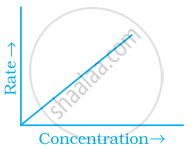 |
|
| (ii) | 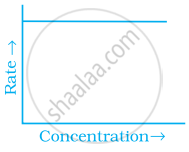 |
(a) 1st order |
| (iii) | 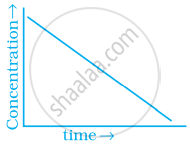 |
(b) Zero-order |
| (iv) | 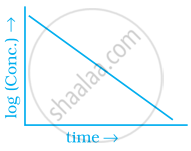 |
The conversion of molecules A to B follow second order kinetics. If concentration of A is increased to three times, how will it affect the rate of formation of B?
A drop of solution (volume 0.05 ml) contains 3.0 × 10⁻⁶ mole of H+. If the rate constant of disappearance of H+ is 1.0 × 10⁷ mole l-1s-1. It would take for H+ in drop to disappear in ______ × 10-9s.
