मराठी

Science (English Medium) इयत्ता १२ - CBSE Question Bank Solutions for Chemistry

Advertisements
विषय
अध्याय
विषय
मुख्य विषय
अध्याय
Advertisements
Advertisements
Chemistry
< prev  2601 to 2620 of 4212  next > 

What is shape selective catalysis?

[5] Surface Chemistry
Chapter: [5] Surface Chemistry
Concept: undefined >> undefined

Copper can be extracted by hydrometallurgy but not zinc. Explain.

[6] General Principles and Processes of Isolation of Elements
Chapter: [6] General Principles and Processes of Isolation of Elements
Concept: undefined >> undefined

Advertisements

What is the role of cryolite in the metallurgy of aluminium?

[6] General Principles and Processes of Isolation of Elements
Chapter: [6] General Principles and Processes of Isolation of Elements
Concept: undefined >> undefined

What is the role of graphite rod in the electrometallurgy of aluminium?

[6] General Principles and Processes of Isolation of Elements
Chapter: [6] General Principles and Processes of Isolation of Elements
Concept: undefined >> undefined

How does the presence of double bonds in rubber molecules influence their structure and reactivity?

[15] Polymers
Chapter: [15] Polymers
Concept: undefined >> undefined

Discuss the main purpose of vulcanisation of rubber.

[15] Polymers
Chapter: [15] Polymers
Concept: undefined >> undefined

Identify the monomer in the following polymeric structures.

[15] Polymers
Chapter: [15] Polymers
Concept: undefined >> undefined

An organic compound with the molecular formula C9H10O forms 2, 4-DNP derivative, reduces Tollens’ reagent and undergoes Cannizzaro reaction. On vigorous oxidation, it gives 1, 2-benzenedicarboxylic acid. Identify the compound.

[8] Aldehydes, Ketones and Carboxylic Acids
Chapter: [8] Aldehydes, Ketones and Carboxylic Acids
Concept: undefined >> undefined

Describe the following:

Cannizzaro reaction

[8] Aldehydes, Ketones and Carboxylic Acids
Chapter: [8] Aldehydes, Ketones and Carboxylic Acids
Concept: undefined >> undefined

Ortho and para nitrophenols are more acidic than phenol. Draw the resonance structures of the corresponding phenoxide ions.

[7] Alcohols, Phenols and Ethers
Chapter: [7] Alcohols, Phenols and Ethers
Concept: undefined >> undefined

Show how will you synthesize pentan-1-ol using a suitable alkyl halide.

[7] Alcohols, Phenols and Ethers
Chapter: [7] Alcohols, Phenols and Ethers
Concept: undefined >> undefined

Give the equation of the following reaction:

Oxidation of propan-1-ol with alkaline KMnO4 solution.

[7] Alcohols, Phenols and Ethers
Chapter: [7] Alcohols, Phenols and Ethers
Concept: undefined >> undefined

Give the equation of the following reaction: 

Dilute HNO3 with phenol.

[7] Alcohols, Phenols and Ethers
Chapter: [7] Alcohols, Phenols and Ethers
Concept: undefined >> undefined

Give the equation of the following reaction:

Treating phenol with chloroform in the presence of aqueous NaOH.

[7] Alcohols, Phenols and Ethers
Chapter: [7] Alcohols, Phenols and Ethers
Concept: undefined >> undefined

Write the mechanism of acid-catalysed dehydration of ethanol to yield ethene.

[7] Alcohols, Phenols and Ethers
Chapter: [7] Alcohols, Phenols and Ethers
Concept: undefined >> undefined

Name the reagent used in the following reaction: 

Oxidation of a primary alcohol to carboxylic acid.

[7] Alcohols, Phenols and Ethers
Chapter: [7] Alcohols, Phenols and Ethers
Concept: undefined >> undefined

Name the reagent used in the following reaction:

Oxidation of a primary alcohol to aldehyde.

[7] Alcohols, Phenols and Ethers
Chapter: [7] Alcohols, Phenols and Ethers
Concept: undefined >> undefined

Name the reagent used in the following reaction:

Benzyl alcohol to benzoic acid.

[7] Alcohols, Phenols and Ethers
Chapter: [7] Alcohols, Phenols and Ethers
Concept: undefined >> undefined

When 3-methylbutan-2-ol is treated with HBr, the following reaction takes place:

\[\begin{array}{cc}
\phantom{...................................}\ce{Br}\\
\phantom{..................................}|\\
\ce{CH3 - CH - CH - CH3 ->[HBr] CH3 - C - CH2 - CH3}\\
|\phantom{.........}|\phantom{...................................}|\phantom{...........}\\
\ce{CH3}\phantom{...}\ce{OH}\phantom{...............................}\ce{CH3}\phantom{.......}\\
\end{array}\]

Give a mechanism for this reaction.

(Hint: The secondary carbocation formed in step II rearranges to a more

stable tertiary carbocation by a hydride ion shift from 3rd carbon atom.)

[7] Alcohols, Phenols and Ethers
Chapter: [7] Alcohols, Phenols and Ethers
Concept: undefined >> undefined

Identify A, B, C, D, E, R and R1 in the following:
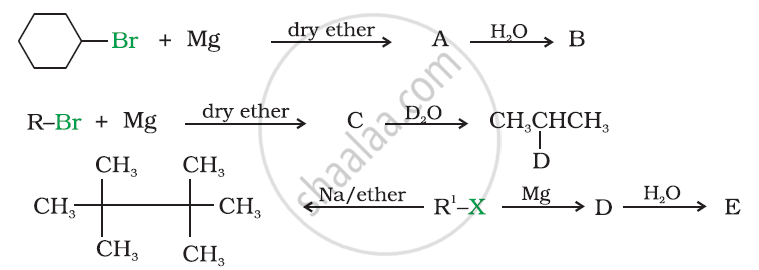
[6] Haloalkanes and Haloarenes
Chapter: [6] Haloalkanes and Haloarenes
Concept: undefined >> undefined
< prev  2601 to 2620 of 4212  next > 
Advertisements
Advertisements
CBSE Science (English Medium) इयत्ता १२ Question Bank Solutions
Question Bank Solutions for CBSE Science (English Medium) इयत्ता १२ Biology
Question Bank Solutions for CBSE Science (English Medium) इयत्ता १२ Chemistry
Question Bank Solutions for CBSE Science (English Medium) इयत्ता १२ Computer Science (C++)
Question Bank Solutions for CBSE Science (English Medium) इयत्ता १२ English Core
Question Bank Solutions for CBSE Science (English Medium) इयत्ता १२ English Elective - NCERT
Question Bank Solutions for CBSE Science (English Medium) इयत्ता १२ Entrepreneurship
Question Bank Solutions for CBSE Science (English Medium) इयत्ता १२ Hindi (Core)
Question Bank Solutions for CBSE Science (English Medium) इयत्ता १२ Hindi (Elective)
Question Bank Solutions for CBSE Science (English Medium) इयत्ता १२ History
Question Bank Solutions for CBSE Science (English Medium) इयत्ता १२ Informatics Practices
Question Bank Solutions for CBSE Science (English Medium) इयत्ता १२ Mathematics
Question Bank Solutions for CBSE Science (English Medium) इयत्ता १२ Physical Education
Question Bank Solutions for CBSE Science (English Medium) इयत्ता १२ Physics
Question Bank Solutions for CBSE Science (English Medium) इयत्ता १२ Political Science
Question Bank Solutions for CBSE Science (English Medium) इयत्ता १२ Psychology
Question Bank Solutions for CBSE Science (English Medium) इयत्ता १२ Sanskrit (Core)
Question Bank Solutions for CBSE Science (English Medium) इयत्ता १२ Sanskrit (Elective)
Question Bank Solutions for CBSE Science (English Medium) इयत्ता १२ Sociology
Share
Notifications

Englishहिंदीमराठी


      Forgot password?
Use app×