Advertisements
Advertisements
Can a galvanometer as such be used for measuring the current? Explain.
Concept: undefined >> undefined
Derive the expression for the electric potential due to an electric dipole at a point on its axial line.
Concept: undefined >> undefined
Advertisements
Depict the equipotential surfaces due to an electric dipole.
Concept: undefined >> undefined
(i)Obtain the expression for the torque `vecτ` experienced by an electric dipole of dipole moment `vecP` in a uniform electric field, `vecE` .
(ii) What will happen if the field were not uniform?
Concept: undefined >> undefined
The power of a combination of two lenses X and Y is 5 D. If the focal length of lens X be 15 cm :
(a) calculate the focal length of lens Y.
(b) state the nature of lens Y.
Concept: undefined >> undefined
- Define torque acting on a dipole of dipole moment \[\vec{p}\] placed in a uniform electric field \[\vec{E}\] Express it in the vector from and point out the direction along which it acts. Express it in the vector from and point out the direction along which it acts.
- What happens if the field is non-uniform?
- What would happen if the external field
\[\vec{E}\] is increasing (i) parallel to \[\vec{p}\] and (ii) anti-parallel to \[\vec{p}\]?
Concept: undefined >> undefined
With the help of a neat and labelled diagram, explain the principle and working of a moving coil galvanometer ?
Concept: undefined >> undefined
Define current sensitivity of a galvanometer.
Concept: undefined >> undefined
Write the expression for the torque \[\vec{\tau}\] acting on a dipole of dipole moment \[\vec{p}\] placed in an electric field \[\vec{E}\].
Concept: undefined >> undefined
Why does a galvanometer when connected in series with a capacitor show a momentary deflection, when it is being charged or discharged?
How does this observation lead to modifying the Ampere's circuital law?
Hence write the generalised expression of Ampere's law.
Concept: undefined >> undefined
Answer the following question :
Define 'bandwidth' and describe briefly its importance in communicating signals ?
Concept: undefined >> undefined
Find the resultant electric field due to an electric dipole of dipole moment, 2aq, (2a being the separation between the charges ±± q) at a point distant 'x' on its equator.
Concept: undefined >> undefined
An electric dipole of length 2 cm, when placed with its axis making an angle of 60° with a uniform electric field, experiences a torque of \[8\sqrt{3}\] Nm. Calculate the potential energy of the dipole, if it has a charge \[\pm\] 4 nC.
Concept: undefined >> undefined
An electric dipole of length 1 cm, which placed with its axis making an angle of 60° with uniform electric field, experience a torque of \[6\sqrt{3} Nm\] . Calculate the potential energy of the dipole if it has charge ±2 nC.
Concept: undefined >> undefined
Block diagram of a receiver is shown in the figure:
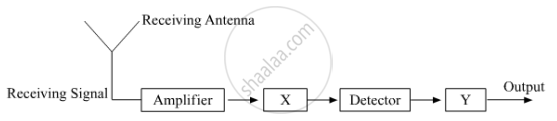
(a) Identify ‘X’ and ‘Y’.
(b) Write their functions.
Concept: undefined >> undefined
Define the current sensitivity of a galvanometer ?
Concept: undefined >> undefined
Write current sensitivity of a galvanomete S.I. unit.
Concept: undefined >> undefined
Figure shows two circuits each having a galvanometer and a battery of 3V.
When the galvanometers in each arrangement do not show any deflection, obtain the ratio R1/R2.

Concept: undefined >> undefined
Define electric dipole moment. Is it a scalar or a vector? Derive the expression for the electric field of a dipole at a point on the equatorial plane of the dipole.
Concept: undefined >> undefined
Distinguish between ‘Analog and Digital signals’.
Concept: undefined >> undefined
