Please select a subject first
Advertisements
Advertisements
Describe an activity to show that colours of white light splitted by a glass prism can be recombined to get white light by another identical glass prism. Also draw ray diagram to show the recombination of the spectrum of white light.
Concept: undefined >> undefined
In the following ray diagram the correctly marked angle are:

(a) ∠i and ∠e
(b) ∠A and ∠D
(c) ∠i, ∠e and ∠D
(d) ∠r, ∠A and ∠D
Concept: undefined >> undefined
Advertisements
Study the following figure in which a student has marked the angle of incidence (∠i), angle of refraction (∠r), angle of emergence (∠e), angle of prism (∠A) and the angle of deviation (∠D). The correctly marked angles are
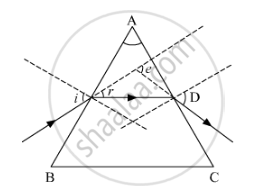
(a) ∠A and ∠i
(b) ∠A, ∠i and ∠r
(c) ∠A, ∠i, ∠e and ∠D
(d) ∠A, ∠i, ∠r and ∠D
Concept: undefined >> undefined
State the cause of dispersion of white light passing through a glass prism. How did Newton show that white light of sun contains seven colours using two identical glass prisms. Draw a ray diagram to show the path of light when two identical glass prisms are arranged together in inverted position with respect to each other and a narrow beam of white light is allowed to fall obliquely on one of the focus of the first prism.
Concept: undefined >> undefined
After tracing the path of a ray of light through a glass prism a student marked the angle of incidence (∠i), angle of refraction (∠r) angle of emergence (∠e) and the angle of deviation (∠D) as shown in the diagram. The correctly marked angles are :

(A) ∠i and ∠r
(B) ∠i and ∠e
(C) ∠i, ∠e and ∠D
(D) ∠i, ∠r and ∠e
Concept: undefined >> undefined
The path of a ray of light passing through a glass prism is shown below:
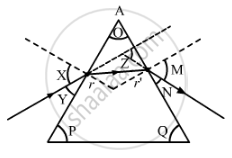
In this diagram, the angle of prism, angle of incidence, angle of emergence and angle of deviation, respectively, have been represented by:
(A) O, Y, Z and N,
(B) P, Y, M and Z,
(C) O, X, M and Z,
(D) P, X, Z and N.
Concept: undefined >> undefined
A student is observing a diagram showing the path of a ray of light passing through a glass prism. He would find that for all angles of incidence the ray of light bends:
Concept: undefined >> undefined
Why do we apply paint on iron articles?
Concept: undefined >> undefined
Explain the term corrosion.
Concept: undefined >> undefined
Which metals do not corrode easily?
Concept: undefined >> undefined
What are alloys?
Concept: undefined >> undefined
Which of the following methods is suitable for preventing an iron frying pan from rusting?
Concept: undefined >> undefined
Give reasons:
Platinum, gold and silver are used to make jewellery.
Concept: undefined >> undefined
Draw a ray diagram to explain the term angle of deviation.
Concept: undefined >> undefined
Why do the component colours of incident white light split into a spectrum while passing through a glass prism, explain
Concept: undefined >> undefined
In the following diagram the correctly marked angles are :

(a) ∠A and ∠e
(b) ∠i, ∠A and ∠D
(c) ∠A ∠r and ∠e
(b) ∠A ∠r and ∠D
Concept: undefined >> undefined
Study the following ray diagram:
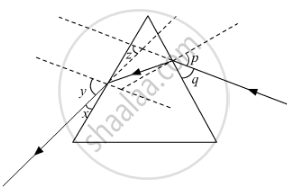
In this diagram, the angle of incidence, the angle of emergence and the angle of deviation respectively have been represented by
(A) y, p, z
(B) x, q, z
(C) p, y, z
(D) p, z, y
Concept: undefined >> undefined
Define the term dispersion of white light.
Concept: undefined >> undefined
Draw a ray diagram to show the dispersion of white light.
Concept: undefined >> undefined
State the cause of dispersion of white light
Concept: undefined >> undefined
