Please select a subject first
Advertisements
Advertisements
AB and CD, two spherical mirrors, from parts of a hollow spherical ball with its centre at O as shown in the diagram. If arc AB = `1/2` arc CD, what is the ratio of their focal lengths? State which of the two mirrors will always form virtual image of an object placed in front of it and why.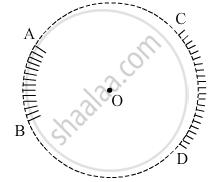
Concept: undefined >> undefined
A student obtained on a screen the sharp image of a candle flame placed at the farther end of laboratory table using a concave mirror. For getting better value of focal length of the mirror, the teacher suggested to him to focus the sun. What should the student do?
(A) Should move the mirror away from the screen.
(B) Should move the mirror towards the screen.
(C) Should move the mirror and screen both towards the sun.
(D) Should move only the screen towards the sun.
Concept: undefined >> undefined
Advertisements
Mention the types of mirrors used as (i) rear view mirrors, (ii) shaving mirrors. List two reasons to justify your answers in each case.
Concept: undefined >> undefined
A student obtained a sharp image of a burning candle, placed at the farther end of a laboratory table, on a screen using a concave mirror. For getting better value of focal length of the mirror, the subject teacher suggested him for focusing a well illuminated distant object. What should the student do?
(A) He should move the mirror away from the screen.
(B) He should move the mirror slightly towards the screen.
(C) He should move the mirror as well as the screen towards the newly selected object.
(D) He should move only the screen towards the newly selected object.
Concept: undefined >> undefined
State the types of mirrors used for (i) headlights and (ii) rear view mirror, in cars and motorcycles. Give to justify your answer in each case.
Concept: undefined >> undefined
Draw a ray diagram to show the formation of the image, when the object is placed between optical centre and principal focus of a convex lens.
State the signs and values of magnifications in the above mentioned case.
Concept: undefined >> undefined
Answer the following question.
Write the modification in the curvature of the eye lens which enables us to see the nearby objects clearly?
Concept: undefined >> undefined
In torches, search lights and headlights of vehicles the bulb is placed ______.
Concept: undefined >> undefined
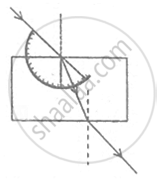
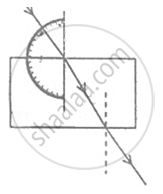
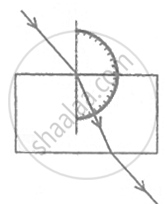
A student traces the path of a ray of light passing through a rectangular slab.
 |
 |
 |
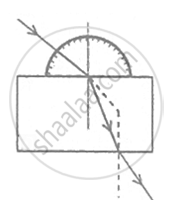 |
For measuring the angle of incidence, he must position the protractor in the manner shown in the figure:
Concept: undefined >> undefined
An object is placed at a distance of 0.25 m
in front of a plane mirror. The distance between the object and image will be ______.
Concept: undefined >> undefined
If the real image of a candle flame formed by a lens is three times the size of the flame and the distance between lens and image is 80 cm, at what distance should the candle be placed from the lens?
Concept: undefined >> undefined
Name the type of mirror used in the following situation:
Side/rear-view mirror of a vehicle
Support your answer with reason.
Concept: undefined >> undefined
Name the type of mirror used in the following situation:
Solar furnace
Support your answer with reason.
Concept: undefined >> undefined
Size of image of an object by a mirror having a focal length of 20 cm is observed to be reduced to 1/3rd of its size. At what distance the object has been placed from the mirror? What is the nature of the image and the mirror?
Concept: undefined >> undefined
Define the following terms in the context of a diverging mirror:
- Principal focus
- Focal length
Draw a labelled ray diagram to illustrate your answer.
Concept: undefined >> undefined
Write two methods of preventing the rusting of iron.
Concept: undefined >> undefined
A student traces the path of a ray of light through a triangular glass prism for different values of angle of incidence. On analyzing the ray diagrams, which one of the following conclusions is he likely to draw?
(A) The emergent ray is parallel to the incident ray.
(B) The emergent ray bends at an angle to the direction of the incident ray.
(C) The emergent ray and the refracted ray are at right angles to each other.
(D) The emergent ray is perpendicular to the incident ray.
Concept: undefined >> undefined
A narrow beam PQ of white light is passing through a glass prism ABC as shown in the diagram.

Trace it on your answer sheet and show the path of the emergent beam as observed on the screen DE.
(i) Write the name and cause of the phenomenon observed.
(ii) Where else in nature is this phenomenon observed?
(iii) Based on this observation, state the conclusion which can be drawn about the constituents of white light.
Concept: undefined >> undefined
In the following diagram, the path of a ray of light passing through a glass prism is shown:
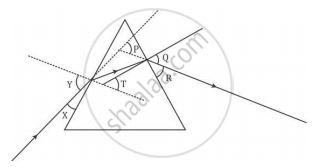
In this diagram the angle of incidence, the angle of emergence and the angle of deviation respectively are (select the correct option):
(A) X, R and T
(B) Y, Q and T
(C) X, Q and P
(D) Y, Q and P
Concept: undefined >> undefined
Study the following diagrams in which the path of a ray of light passing through a glass prism as traced by four students P, Q, R and S is shown:

The student who has traced the path correctly is
(A) P
(B) Q
(C) R
(D) S
Concept: undefined >> undefined
